
If you have sat in a revenue review where the CRM data said one thing, the forecast spreadsheet said another, and the commission calculation was different again you already understand the problem that Revenue Operations was built to solve.
Revenue Operations, almost universally shortened to RevOps, has gone from a niche concept discussed at SaaS conferences in 2019 to the single most important structural shift in how high-performing B2B sales organizations run in 2026. Yet most companies still don’t have a clear definition of what RevOps actually is, what it requires, or why their current tool stack is actively working against it.
This guide covers all of it. What RevOps is, why it matters, what it demands from your technology, and what the best B2B sales teams are doing differently.
What Is Revenue Operations (RevOps)?
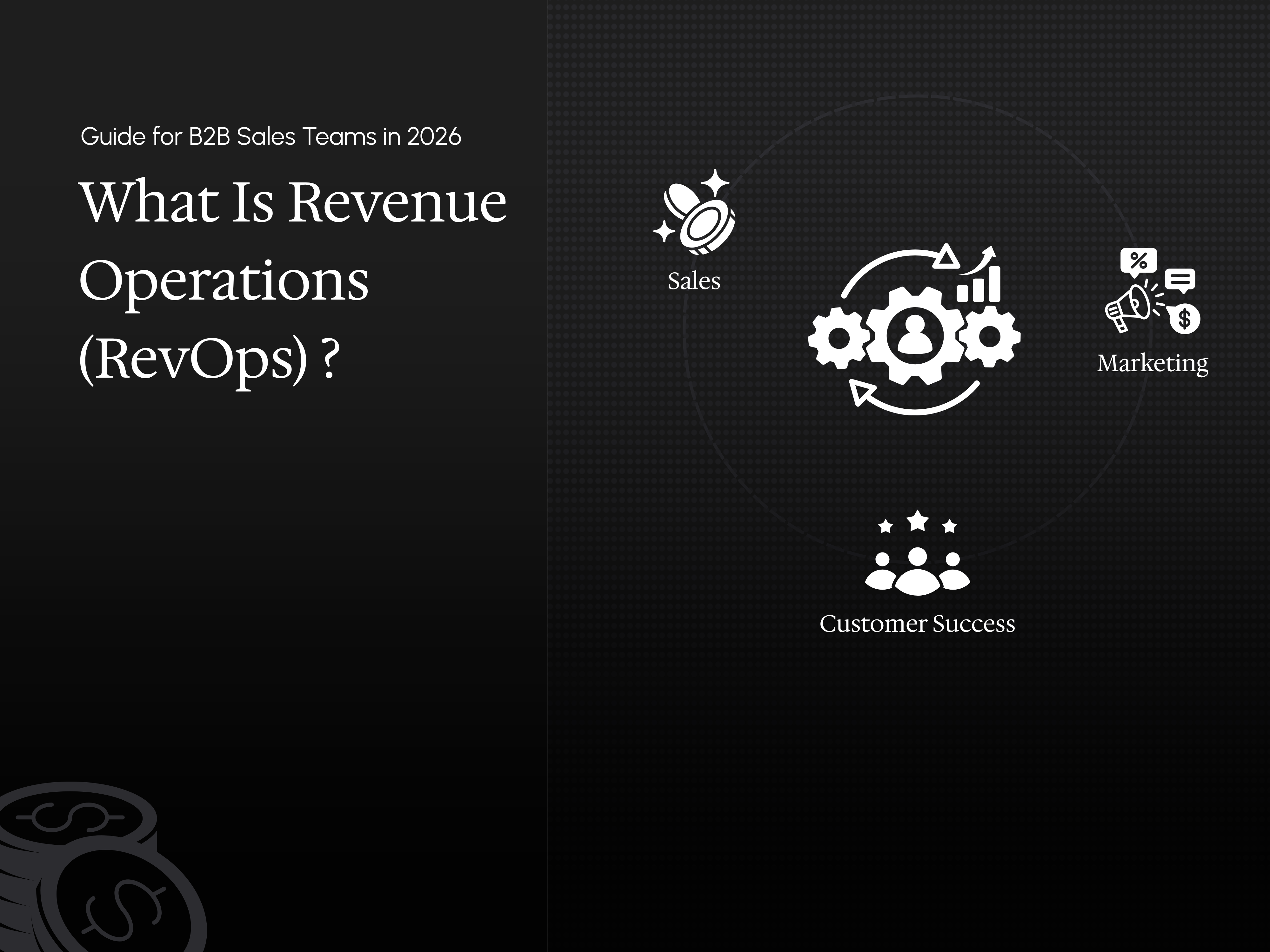
Revenue Operations (RevOps) is the alignment of your sales, marketing, and customer success teams under a single operational framework sharing one data model, one set of processes, and one source of truth for revenue performance.
The core idea is simple: revenue is not generated by sales alone. It is the result of marketing finding the right buyers, sales converting them efficiently, and customer success retaining and expanding them. When those three functions operate in silos with separate tools, separate data, and separate reporting the result is a fragmented view of the business that makes forecasting unreliable, decision-making slow, and growth harder than it needs to be.
RevOps fixes this by connecting all three functions at the operational level.
In practice, a Revenue Operations function owns:
- The CRM and its data integrity
- Sales forecasting methodology and accuracy
- Pipeline reporting and deal-stage definitions
- Sales compensation and commission management
- Sales enablement content and its effectiveness
- Technology stack decisions and integrations
- Onboarding and ramp time for new sales reps
When RevOps is working, your CRO walks into a board meeting with a forecast number they actually believe. Your reps know exactly what they need to close to hit their accelerator. Your VP Marketing knows which campaigns are converting into closed revenue, not just pipeline.
Why Revenue Operations Has Become Non-Negotiable in 2026
TFive years ago, RevOps was a competitive advantage. Today it is a baseline requirement for any B2B SaaS company that wants to scale past a certain point without chaos.
Here is what has changed:
Buyers are more informed and harder to sell to. The average B2B deal now involves six to ten stakeholders. Sales cycles are longer. Reps cannot afford to waste time on deals that were never going to close. RevOps gives teams the data intelligence to qualify faster and focus correctly.
The cost of a fragmented sales tech stack has become impossible to ignore. The average B2B SaaS company in 2026 spends between $350 and $500 per sales rep per month on a collection of tools: a CRM, a forecasting platform, a conversation intelligence tool, a sales enablement platform, a commission management system, and a sequencing tool. These tools do not talk to each other natively. Data is duplicated, reconciled manually, and always slightly out of date. RevOps teams spend an enormous proportion of their time managing integrations rather than generating insights.
Forecast accuracy has become a board-level metric. In the current economic environment, CFOs and boards are demanding precision from their revenue leaders. A forecast that misses by 20 to 30 percent is no longer acceptable. RevOps, when properly resourced and tooled, is the function that closes that gap.AI has entered the revenue stack and it only works when the data is clean. AI-driven forecasting, deal intelligence, and sales coaching are all possible in 2026. But they require a unified, real-time data model to function. Fragmented stacks with siloed tools cannot support genuine AI intelligence. RevOps is what creates the conditions for AI to work.
The Four Pillars of a High-Performing RevOps Function
1. A Single Source of Truth for Pipeline Data
The foundation of Revenue Operations is clean, real-time, trustworthy pipeline data. This means every deal in your CRM reflects its actual status not the status a rep entered three days ago based on what they remembered from a call.
In high-performing RevOps teams, pipeline data is updated automatically from calls, emails, and calendar activity. Deal stages are validated against objective criteria MEDDPICC qualification fields, engagement recency, stakeholder mapping not rep optimism.
When your pipeline data is real, everything built on top of it forecasting, capacity planning, commission calculations becomes reliable.
2. Forecast Accuracy That Can Be Defended
Revenue Operations owns the forecast. Not just the number, but the methodology behind it and the confidence level attached to it.
A mature RevOps team has:
- Clear definitions for Commit, Best Case, and Pipeline tiers
- A structured process for deal review that challenges assumptions
- Signals from actual deal activity email response rates, meeting recency, stakeholder engagement that validate or contradict a rep’s forecast entry
- Historical data that shows how well past forecasts predicted actual outcomes
The industry average forecast accuracy for B2B SaaS companies is below 50 percent. Teams with a mature RevOps function and the right tools routinely operate at 80 to 90 percent accuracy. That gap represents real money deals that would have been lost to poor prioritisation, resources misallocated based on a bad number, and credibility with the board that takes years to rebuild after a miss.
3. Compensation That Drives the Right Behaviour
Commission management sits inside RevOps for a reason. How you pay your reps directly shapes what they do. If reps cannot see their earnings in real time, they make suboptimal decisions about which deals to prioritise. If commission calculations are done in spreadsheets reconciled at the end of the month, disputes are inevitable and trust erodes.
High-performing RevOps teams give reps live visibility into their commission position against every deal in their pipeline. They can see, in real time, how closing a specific deal moves them toward the next accelerator threshold. This is not just a nice-to-have it is a proven driver of rep behaviour and motivation.
Equally important, Finance needs to trust the commission outputs. When commissions are calculated on the same data model as the CRM and the forecast, there is nothing to reconcile. One source of truth eliminates the spreadsheet fight that happens at the end of every quarter in most companies.
4. Enablement That Actually Gets Used
The final pillar of Revenue Operations is sales enablement ensuring that reps have the right content, coaching, and competitive intelligence at the right moment in every deal.
Most sales enablement programmes fail for a simple reason: the content exists somewhere, but reps do not use it. It lives in a portal they have to remember to log into. It is not surfaced in the context of the deal they are working on right now. By the time a rep remembers that a battle card exists, they have already stumbled through the objection without it.
Effective RevOps integrates enablement into the sales workflow itself. Content is surfaced in the CRM, at the deal stage where it is relevant, by a system that understands the current state of the opportunity. A rep handling a late-stage competitive deal with a Salesforce/Hubspot incumbent should automatically see the comparison card. They should not have to search for it.
The RevOps Tech Stack Problem – And Why It Has Become Worse
The conventional wisdom for building a RevOps tech stack has always been to buy the best tool for each job: Salesforce for CRM, Clari or Gong for forecasting, Highspot or Seismic for enablement, SPIFF or Xactly for commissions, Outreach or Salesloft for sequencing.
In theory, this sounds logical. In practice, it creates five or six separate data models that never fully synchronise, integration maintenance that consumes RevOps bandwidth, and a cost structure that most companies cannot justify as they scale.
Here is what that stack actually costs for a 40-person sales team in 2026:
| Tool | Purpose | Approximate Monthly Cost (40 reps) |
| Salesforce Sales Cloud | CRM | $6,000 |
| Clari or Gong | Forecasting + Conversation Intel | $6,000 |
| Highspot or Seismic | Sales Enablement | $2,000 |
| SPIFF or Xactly | Commission Management | $2,000 |
| Outreach or Salesloft | Sequencing | $4,000 |
| Total | $20,000/month |
That is $240,000 per year, before implementation costs, integration maintenance, or the professional services fees that Salesforce charges for any meaningful configuration work.
And despite spending $500 per rep per month, most teams are still running commission disputes in spreadsheets, forecasting in PowerPoint presentations assembled the morning of the board call, and watching enablement content go unused because it is not connected to the CRM where reps actually spend their time.
The fragmentation is the problem. No amount of integration work fully solves it because each tool was built on its own data model, with its own definition of what a deal is, what a stage means, and what a rep’s activity looks like.
How AI-Native Revenue Operations Platforms Are Changing This
The shift that is happening in 2026 is not incremental. It is architectural.
A new category of AI-native Revenue Operations platform has emerged built from the ground up on a single data model, with artificial intelligence embedded at the core rather than bolted on as an add-on module. These platforms replace the fragmented stack entirely, not by compromising on any individual capability, but by building CRM, forecasting, enablement, commissions, and conversation intelligence on one shared foundation.
The result is fundamentally different from what was possible before:
Real-time deal intelligence becomes possible because every email, call, and meeting is captured and processed by the same AI that reads the pipeline. There is no sync delay. There is no data that lives in one tool but not another. The AI has the full picture of every deal, updated continuously.
Forecast accuracy improves dramatically because the AI can cross-reference a rep’s forecast entry against their actual engagement with the account. If a rep marks a deal as Commit but has not had a conversation with the economic buyer in two weeks, the system flags it before the Monday call not after the quarter ends.
Commission disputes disappear because commissions are calculated on the same deal records that drive the CRM and the forecast. Finance, management, and reps are all looking at the same number, updated in real time as deals progress.
Enablement gets used because the content is surfaced inside the deal workflow, by an AI that understands what stage the deal is at, who the stakeholders are, and what objections are likely at this point in the sales cycle.
CRM adoption goes up because reps no longer have to do manual data entry. The AI reads their calls and emails, updates the deal record automatically, and gives them a daily briefing on what needs their attention today. Opening the platform feels useful, not administrative.
What to Look for in a Revenue Operations Platform in 2026
If you are evaluating Revenue Operations software for your team, here are the questions that separate genuine AI-native platforms from traditional tools with an AI layer painted on top:
Is the AI built into the data model or added on top? If the AI module costs extra, requires an upgrade, or only reads a subset of your deal data, it is an add-on. Genuine AI-native platforms have the intelligence layer at the foundation – it reads everything, in real time, without additional configuration.
Does it eliminate tools or just connect them? A platform that connects your existing tools is an integration layer, not a RevOps platform. The goal is to consolidate onto one data model, not to add another connector in the middle of your existing stack.
Can reps use it without being forced to? CRM adoption at most companies sits at 34 percent. If the platform requires reps to do manual data entry, adoption will be the same as it has always been. Look for platforms where the AI does the data entry on behalf of the rep, reading calls, emails, and meetings automatically.
Does the forecast methodology include objective signals? If the forecasting is based solely on rep-entered data, it will be as accurate as your reps are honest. Look for forecast validation against engagement signals – email recency, meeting attendance, stakeholder coverage – that the AI can read independently.
Is commission data live and visible to reps? Real-time commission visibility inside every deal is a meaningful driver of rep motivation and deal prioritisation. If the commission data is reconciled monthly in a spreadsheet, it is not part of your RevOps platform – it is a separate problem
Revenue Operations Is Not a Headcount Problem
One of the most common misconceptions about RevOps is that it requires a large dedicated team to be effective. In reality, a well-tooled RevOps function of one or two people can support a sales organisation of fifty to one hundred reps – if the technology is doing the heavy lifting.
The RevOps teams that are still spending most of their time on data reconciliation, integration maintenance, and spreadsheet commission calculations are in that position because their tools require it. They are doing manually what the technology should be doing automatically.
The shift to an AI-native Revenue Operations platform does not replace the RevOps function – it frees it to do the work that actually drives revenue: analysing patterns in win and loss data, refining qualification criteria, designing compensation plans that drive the right behaviours, and building the onboarding programmes that get new reps to full productivity faster.
The Bottom Line for B2B Sales Leaders
Revenue Operations in 2026 is not optional for any B2B SaaS company that wants to grow predictably. The question is not whether to invest in RevOps – it is whether to build it on a fragmented stack of five to six tools that will never fully talk to each other, or on a unified AI-native platform that treats CRM, forecasting, enablement, commissions, and conversation intelligence as one connected system.
The teams that get this right have forecast numbers they believe, commission processes that Finance trusts, enablement that reps actually use, and CRM adoption rates above 90 percent. The teams that do not are spending more per rep per month, getting less visibility, and losing deals that better-informed competitors are winning.
The technology to do this exists today. The only question is how long to wait before making the switch.
Frequently Asked Questions About Revenue Operations
What is the difference between Sales Operations and Revenue Operations?
Sales Operations traditionally focuses on the sales team’s internal processes CRM administration, territory management, quota setting, and sales reporting. Revenue Operations is broader: it aligns sales, marketing, and customer success under one operational framework, with a shared data model and unified reporting across the entire revenue cycle. RevOps owns the full funnel, not just the sales stage.
What is the most important metric for a Revenue Operations team?
Forecast accuracy is the single most important RevOps metric because it is a proxy for data quality, process discipline, and business predictability. Secondary metrics include CRM adoption rate, average ramp time for new reps, commission dispute rate, and pipeline coverage ratio.
What is the average cost of a RevOps tech stack for a 40-person sales team?
The average fragmented stack -Salesforce, Clari or Gong, Highspot or Seismic, SPIFF or Xactly, Outreach or Salesloft – costs between $400 and $500 per rep per month, or $16,000 to $20,000 per month for a 40-person team. AI-native unified platforms have brought this cost down to $75 per rep per month for comparable or superior capability.
How long does it take to implement a Revenue Operations platform?
Traditional CRM implementations – Salesforce in particular – take three to six months with a system integrator and significant professional services cost. AI-native platforms built on modern architecture can go live in days to weeks, with migration of contacts, pipeline history, and deal stages handled automatically.
Quantum Heaps is an AI-native Revenue OS for B2B sales teams. One platform replacing CRM, forecasting, enablement, commission, and outbound powered by KAI, our AI revenue agent. Start free at quantumheaps.com