
Words matter in software. The category a product places itself in determines which problems it is expected to solve, which buyers evaluate it, which competitors it is measured against, and ultimately whether the market recognises it as something genuinely different or dismisses it as another variant of something that already exists.
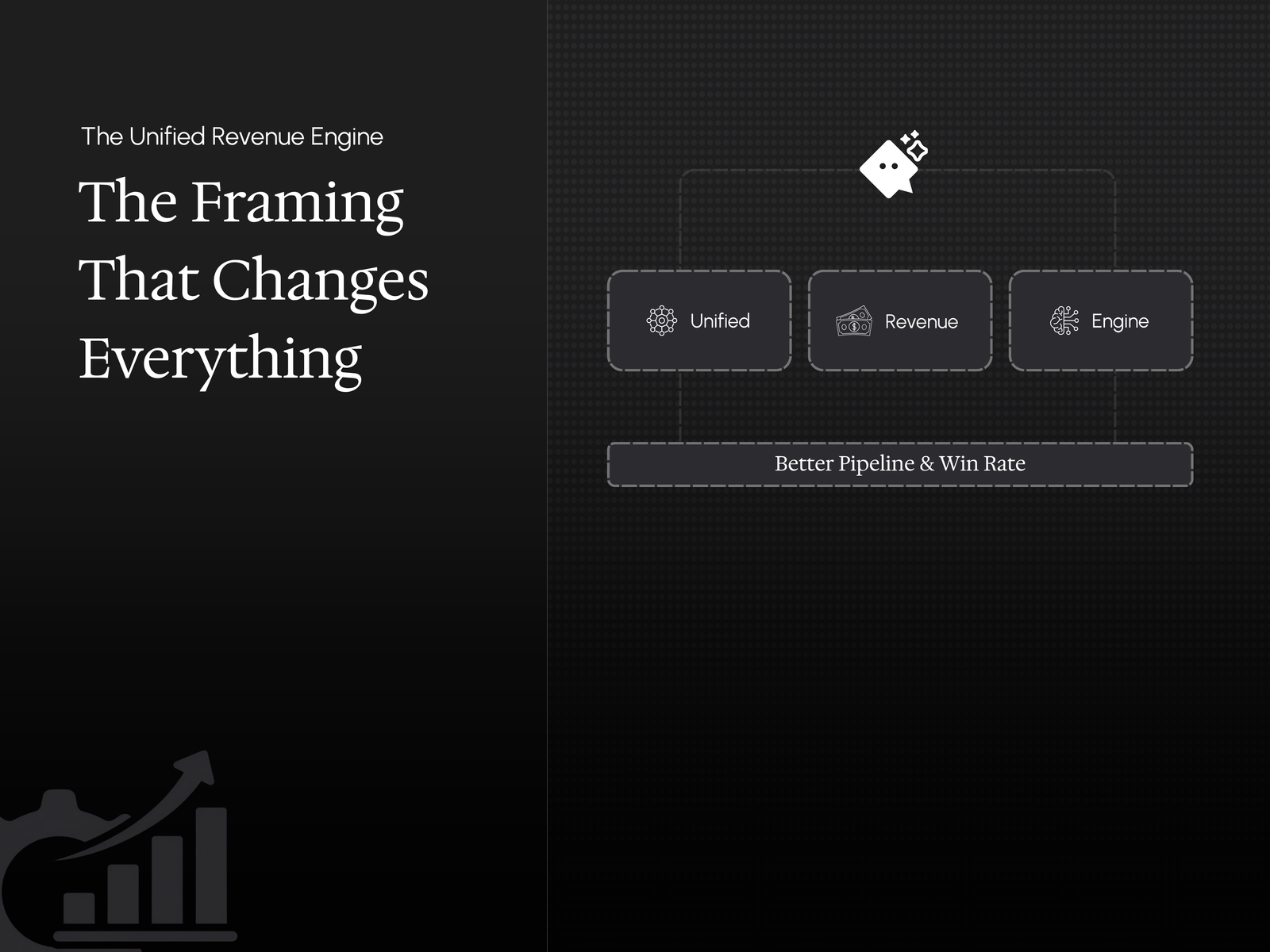
Most revenue platforms are defined by what they store. Quantum Heaps is defined by what it moves. But internally, and increasingly in how we talk with the revenue leaders we work with, the phrase that captures what we are building most precisely is this: a Unified Revenue Engine.
Three words. Each one deliberate. Each one carries a specific meaning that is different from how the existing market of sales and revenue software describes itself.
This blog is about why we chose that framing, what each word means in practice, and why the combination of all three not any one of them in isolation represents the product-market fit that the B2B sales market in 2026 has been building toward for the better part of a decade.
The Problem With Every Other Frame
Before explaining what a Unified Revenue Engine is, it is worth being precise about what it is not and why the categories that currently dominate how revenue software describes itself have stopped adequately describing what revenue teams actually need.
CRM is the oldest and most familiar category. A CRM is a system of record. It stores what happened after a rep enters it. Its core promise is that your customer and deal data is organised and accessible. The problem with the CRM frame in 2026 is that storage is not the bottleneck. The bottleneck is intelligence not keeping records, but knowing what to do with what is in them. A system of record that requires human data entry and human interpretation is not adequate for the speed and complexity of modern B2B revenue operations.
Revenue Intelligence was the next category to emerge, platforms that layered analysis on top of CRM data, reading signals, surfacing insights, and helping revenue leaders understand what was happening in their pipeline. The problem with revenue intelligence as a standalone category is that insight without action is still just a better-organised version of the problem. Knowing a deal is at risk eleven days before it dies is valuable. Knowing it and having a fragmented stack that requires a rep to log into three different tools to act on it is less valuable than it should be.
Revenue Operations as a discipline not a software category, but the organisational function has been the field’s attempt to stitch these things together manually. RevOps teams building and maintaining the integrations, doing the reconciliation, producing the unified view from the fragments. Valuable work, done by smart people, at enormous ongoing cost to the organisation’s capacity for the strategic work that actually moves the revenue number.
None of these frames is wrong. They are all incomplete. The frame that captures what the most forward-thinking revenue teams are actually trying to build is the one that combines the right architecture, the right outcome focus, and the right operational model into a single description.
Unified. Revenue. Engine.
The First Word: Unified
Why Unification Is the Architectural Problem No Integration Can Solve
The fundamental architecture of most B2B sales technology stacks is fragmented by design. Each tool in the stack was built by a different company, on a different data model, with a different definition of what a deal is, what a stage means, what an activity looks like, and what the relationship between a contact and an account represents.
These tools are connected by integration bidirectional syncs that attempt to reconcile the differences between data models by copying data from one to the other on a schedule. The sync runs. The data copies. The definitions are translated. And somewhere in that process, something is lost: recency, precision, the relationship between two data points that each tool holds independently and neither holds jointly.
This is why the VP of Sales described it on our website as: “By the time I pull a forecast, the data is already two days out of date and I’m just making it look presentable.”
The forecast is two days old not because nobody updated it. It is two days old because the system that produced it read from a CRM that was itself reading from a sync cycle that was itself dependent on what reps had entered before that cycle ran. Three delays stacked on top of each other, each one small and each one compounding the others.
Unification, as Quantum Heaps means it, is not a better integration. It is the elimination of the integration problem by building everything on one record from the start.
The commitment is architectural, and the language that describes it is deliberately unambiguous: Prospect, Sale and Manage live in one record. Not integrated. Unified.
That phrase not integrated, unified is the architectural commitment. When every module reads from and writes to the same record, there is no sync delay, no version drift, no reconciliation step. The forecast reflects the current state of the deal because the forecast and the deal are the same record. The commission calculation reflects the current stage of the opportunity because the commission module and the CRM are reading the same data point at the same moment.
This unification is what makes everything else in the platform possible. It is the foundation on which real-time intelligence, accurate forecasting, live commission visibility, and context-aware enablement are all built. Without it, each of those capabilities is slightly less than it should be bounded by the data lag and the version drift that fragmentation makes inevitable.
What Unification Looks Like for a GTM Team
For a go-to-market team, unification changes the working day in specific and measurable ways.
Marketing generates a campaign lead. That lead enters the same record that the sales rep will work when the lead qualifies. The conversation history, the campaign source, the engagement data from the initial outreach all of it is in the record before the rep opens it. There is no handoff moment where data is lost because the marketing platform’s definition of a qualified lead does not match the CRM’s definition of an opportunity.
The rep works the deal. Every email, every call, every meeting is captured automatically by Agent Q and written to the same record. The deal progresses. The stage updates. The commission position for the rep updates in the same moment the stage changes. The forecast entry updates. The at-risk detection runs against the same data that just changed. All of it, from one action, in real time.
This is what the first word means. Not a unified interface. A unified data model the foundation of which makes everything that follows possible.
The Second Word: Revenue
The Six Numbers That Actually Determine Whether a Revenue Organisation Wins
Most sales platforms are built around activity. They measure calls made, emails sent, meetings booked. They surface dashboards of motion. They show what the team is doing.
Revenue teams that are winning in 2026 are not asking what their team is doing. They are asking what their team is producing and specifically, which of the six numbers that determine revenue outcomes are moving in the right direction.
Those six numbers, as the Quantum Heaps Revenue slide names them, are: Clarity, Win Rate, Commission, Rep Productivity, Pipeline, and Forecast Accuracy.
Each one is an outcome, not an activity. And each one is determined by something specific that a Unified Revenue Engine can measure, influence, and improve because all six are connected through the same data model.
Clarity is the CRO’s ability to walk into any meeting and know the current state of the revenue organisation not the state as of the last sync, not the state as assembled by RevOps on Monday morning, but the state right now, pulled from a live data model that is continuously updated by Agent Q reading every signal that touches every deal.
Win Rate is the outcome of every element of the sales process working together with qualification, enablement, competitive intelligence, deal execution, and coaching. On a fragmented stack, win rate decline is difficult to diagnose because the data that would explain it lives in five different tools in five different formats. On a unified platform, win rate by rep, by stage, by deal size, by territory, and by competitive presence is always available, always current, and always traceable to the specific deal-level events that drove it.
Commission is the signal that determines whether reps prioritise the deals that matter. Reps who cannot see their commission position in real time make suboptimal decisions about which deals to push toward close. On Quantum Heaps, every rep sees their live commission earnings inside every deal record and specifically, they see what closing each deal in their pipeline would do to their position against the next accelerator threshold. This is not a dashboard feature. It is a motivation architecture. The result: zero commission disputes, because the rep and Finance are reading the same number from the same source at the same moment.
Rep Productivity is the ratio of time spent selling to time spent on everything else. The industry average CRM adoption rate is 34 percent which means that on any given day, two-thirds of a sales team’s activity is not being captured, because capturing it requires manual work that does not help reps close deals. Agent Q changes this by doing the data entry on the rep’s behalf, reading calls, emails, and calendar events and updating the deal record automatically. The result is 91 percent CRM adoption, not because reps were mandated to comply, but because the system removed the work that was preventing them from using it naturally.
Pipeline is not just a volume metric. It is a quality and velocity metric. A pipeline review that examines only how much pipeline exists misses the questions that matter: which deals are stalling, which are at risk, which have the qualification gaps that historically predict a loss, and which are progressing at the velocity that historically predicts a win? Agent Q answers all of these continuously surfacing at-risk deals an average of eleven days before a human review would identify the same risk.
Forecast Accuracy is the output of everything else working correctly. When the data model is unified, when qualification is validated against objective signals, when at-risk deals are surfaced early, and when tier assignments are cross-referenced against engagement evidence rather than rep confidence forecast accuracy improves from the industry average of 46 percent to 87 percent within ninety days.
These six numbers are interconnected. You cannot improve forecast accuracy without improving pipeline quality. You cannot improve win rate without improving enablement and coaching. You cannot improve rep productivity without removing the administrative burden from the CRM. A unified platform that reads all six through the same data model can improve all six simultaneously because the interventions that move one also move the others.
This is why the second word is Revenue. Not activity. Not a process. Not reporting. Revenue the specific set of outcomes that a B2B sales organisation exists to produce.
The Third Word: Engine
The Difference Between a System of Record and a System of Action
The most important distinction in how Quantum Heaps describes itself is the one carried by the word Engine.
A system of record tells you what happened. A system of action tells you what to do next and, where possible, does it for you.
This is not a positioning statement. It is an architectural description. Agent Q the AI engine at the core of Quantum Heaps is not a feature added to a CRM. It is the operating layer through which every module functions. It reads every deal signal, every communication event, every stage progression, every qualification update and acts on what it reads.
What the Engine Actually Does
Agent Q operates across twelve distinct agent functions, each one addressing a specific operational task that currently requires either manual rep work or a separate tool:
Revenue Forecasting Agents cross-reference every Commit entry against engagement signals, qualification completeness, and stage velocity flagging discrepancies before the Monday call, not after the miss.
Pipeline Health and Deal Risk Agents monitor every active deal continuously, surfacing the patterns that precede a deal going cold, reduced response times, stalled stage progression, missing stakeholder engagement eleven days before a human review would catch the same signal.
CRM Data Hygiene Agents maintain the data quality that makes everything else reliable identifying duplicate records, incomplete qualification fields, and deal stages that do not reflect current deal activity, and correcting them without requiring RevOps intervention.
Lead Routing and Enrichment Agents ensure that every inbound lead is routed to the right rep with the right enrichment context before the first outreach so the first contact is informed, not generic.
Territory and Quota Planning Agents model territory assignment and quota distribution against historical performance data, identifying coverage gaps and capacity misalignments before they affect the quarter’s results.
Quota Attainment and Rep Performance Agents give every manager a live view of each rep’s attainment against ramped quota, their win rate by stage, their MEDDPICC completion scores, and their pipeline coverage of the data that transforms a one-on-one from a status update into a coaching conversation.
Revenue Analytics and Reporting Agents surface the patterns in win and loss data that explain why the numbers are moving not what happened, but why making the revenue review a diagnostic session rather than a reporting session.
Deal Desk and Quote-to-Cash Agents move deals from verbal agreement to signed contract without the handoffs and delays that currently sit between a deal closing and revenue being recognised.
Whitespace and Market Coverage Agents identify expansion opportunities within existing accounts and coverage gaps in the territory map the revenue that is available but not currently being pursued.
Retention and Expansion Agents monitor customer health signals and surface expansion opportunities and churn risks with the same pipeline discipline applied to new business.
Together, these agents do not assist the revenue process. They run it, surfacing the next right action at every step, automating the work that does not require human judgment, and freeing the humans in the system for the judgment that does.
This is what Engine means. Not a tool that stores and displays. A system that reads, reasons, acts, and improves continuously, across every deal in the pipeline simultaneously.
Why This Is the Right Product-Market Fit for 2026
The B2B revenue software market has been converging on this architecture for several years. The signal is visible in the problems that revenue leaders consistently name as their highest priorities: forecast accuracy, win rate improvement, CRM adoption, tech stack cost, and the gap between the data they have and the decisions it should inform.
Each of these problems is a symptom of the same underlying condition: a revenue stack built on fragmented tools, manually maintained integrations, and reactive reporting designed for a world where sales cycles were shorter, buying committees were smaller, and the cost of data lag was lower than it is today.
The architecture that solves these problems is not a better CRM. It is not a smarter forecasting tool. It is not a more capable enablement platform. It is a unified data model with an AI engine that reads every signal continuously, acts on what it reads, and surfaces the outcomes that matter at $75 per user per month, with a free plan for teams of up to five and a 90-day pilot with agreed performance targets for teams that want to measure before they commit.
Unified. Revenue. Engine.
Three words. One architectural commitment. The product-market fit that the B2B sales market has been building toward and that Quantum Heaps has built.
Quantum Heaps is the AI-native Revenue OS for global B2B sales teams built on a single unified data model, powered by Agent Q, and designed to move the six numbers that determine whether a revenue organisation wins. See how it works → | View pricing →