
Here is a scenario that every sales manager in B2B has experienced, usually more than once.
A rep finishes a discovery call with a strong prospect. The call went well by every measure the rep can describe. The prospect asked good questions. The conversation ran over time because the engagement was genuine. There was a clear pain point identified and a follow-up scheduled.
The rep logs the call as a positive interaction in the CRM. They write a one-paragraph note. They mark the next step and move on to the next call.
Two weeks later, the deal is stalling. The manager pulls the rep for a pipeline review. The rep describes the situation confidently. But the manager has a nagging feeling that something was missed in the original conversation. Was the economic buyer actually confirmed? Was the timeline discussed or just assumed? Did a competitor get mentioned that nobody logged?
The answer to all of those questions exists. It is in the recording of that discovery call. But to access it, the manager has to open a separate conversation intelligence platform, search for the call by date or rep name, scrub through a recording, read a transcript that was generated in isolation from any deal context, and then manually connect what they find to the opportunity in the CRM.
By the time this process is complete, another two days have passed. The deal has not moved. And the insight that was sitting in that call recording was never used when it could have changed the outcome.
This is not a technology failure. It is an architectural failure. And it is the default experience for every B2B sales team running conversation intelligence as a standalone tool.
What Conversation Intelligence Actually Is
Conversation intelligence is the capability that captures, transcribes, and analyses every sales interaction and uses that analysis to improve deal outcomes, coach rep performance, and inform revenue decisions.
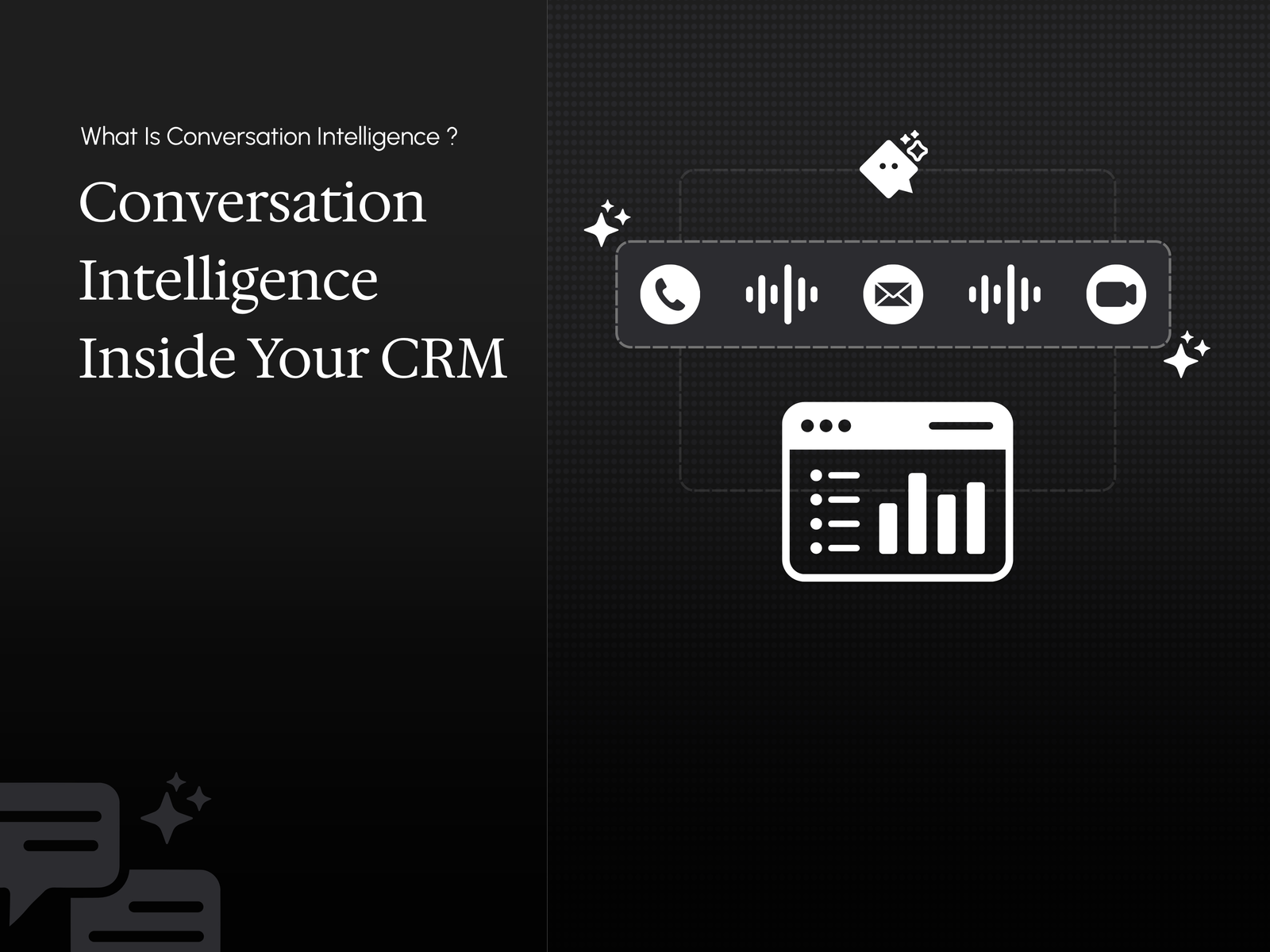
In practice, it covers every channel through which a sales conversation happens: calls recorded and transcribed in real time, emails captured and threaded in the deal context, meetings logged with attendees and outcomes, messaging conversations on platforms like WhatsApp and Slack tracked and associated with the right account.
When it works correctly, conversation intelligence gives a sales organisation something that has historically been invisible: an objective, searchable, analysable record of what was actually said in every customer interaction, connected to the deal that interaction was part of, and available to everyone who needs it from the rep who made the call to the CRO reviewing the forecast on a Sunday evening.
The intelligence comes not just from having the record, but from what the AI layer does with it. Which topics came up most frequently in calls that closed? Which objections appear consistently at a specific stage? Which competitors are being mentioned in deals above a certain size? Which reps are handling the pricing conversation in a way that correlates with a shorter close time? These are questions that conversation intelligence, done correctly, answers automatically rather than requiring a manual analysis project.
The problem in 2026 is not that conversation intelligence is unavailable. It is that the way most sales organisations have deployed it has created a new version of the fragmentation problem it was supposed to solve.
The Standalone Tool Problem
The conversation intelligence market emerged as a standalone category for a straightforward reason: the CRMs that most sales teams were using were not built to capture and analyse conversation data. Call recordings lived in the dialler. Email threads lived in the email client. Meeting notes lived in documents or in manually entered CRM fields. The conversation intelligence platform was purchased to aggregate all of this into one place and make it searchable and analysable.
This solved one problem and created another.
The problem it solved: sales managers gained the ability to review calls, listen back to key moments, and coach reps based on what actually happened in a conversation rather than on the rep’s summary of what happened.
The problem it created: a new data silo. The conversation intelligence platform became the sixth or seventh tool in the stack with its own login, its own data model, its own definition of what a deal is, and its own analysis that lived in isolation from the pipeline data, the forecast data, the enablement data, and the commission data that were all sitting in other tools simultaneously.
The practical consequence is visible in three specific failures that every sales organisation running a standalone conversation intelligence tool experiences with enough regularity to recognise them.
Failure One: The Insight That Arrives Too Late
A conversation intelligence platform processes a call. The AI identifies that a key competitor was mentioned. It flags that the economic buyer was not present on the call. It notes that the prospect’s language shifted from exploratory to evaluative, suggesting they are further along in their decision process than the stage classification in the CRM indicates.
These are valuable signals. The question is: when does the rep or the manager see them?
In a standalone tool, the answer is: when they log into the standalone tool. Which happens during a dedicated review session, usually scheduled for the purpose, usually when the manager has time, usually not the same day the call happened.
In a deal that is moving, a one-day or two-day lag between a conversation happening and its intelligence being acted on is the difference between a timely response and a missed window. The prospect who mentioned a competitor on Tuesday is being actively courted by that competitor on Wednesday. The intervention that would have been effective on Tuesday afternoon is less effective on Thursday morning.
Failure Two: The Coaching That Never Connects to the Deal
Sales coaching based on conversation intelligence should be specific, timely, and connected to the deal the conversation was part of. It should tell a rep: in this deal, at this stage, when this type of prospect asks this type of question, here is what the data says works.
When the conversation data lives in a separate tool from the deal data, coaching cannot be this specific. The manager can say: here is what you said in this call, and here is what I think you should have said. But they cannot say: here is what you said in this call, here is how it compares to what your top performers say in the same situation, and here is the enablement content that would have given you a stronger answer because it is directly relevant to this deal’s stage, this prospect’s profile, and this objection pattern.
That second version of coaching requires the conversation data and the deal data to be in the same place. In a fragmented stack, they are not.
Failure Three: The CRM That Still Does Not Know What Happened
A rep has twelve calls in a week. The conversation intelligence platform records all twelve and generates transcripts and summaries. The CRM shows twelve logged calls with the notes the rep typed.
The two records almost never match. The CRM shows what the rep remembered and chose to enter. The conversation intelligence platform shows what was actually said. The gap between them is where deal risk hides, where qualification assumptions live that were never confirmed, and where the forecast entry of Commit is based on an optimism that the conversation data does not support.
When these two systems cannot communicate in real time, the CRM that drives the forecast is always built on incomplete information. The pipeline review that happens on Monday morning is reviewing a version of reality that the conversation data could have corrected if it had been integrated into the same record.
What Changes When Conversation Intelligence Lives Inside the CRM
The architectural shift that Quantum Heaps represents in how conversation intelligence works is not a feature improvement. It is a structural change in where the conversation data lives and therefore what becomes possible with it.
When conversations are captured in the same record as the deal, everything that touches that deal immediately has access to the full conversation history. Not after a sync. Not after the rep exports a summary. At the moment the conversation ends.
This changes five things simultaneously.
The Deal Record Becomes Complete
Every email, every call, every meeting, every WhatsApp message and Slack thread connected to an account is captured automatically and written to the same deal record that drives the pipeline, the forecast, and the commission calculation. The rep does not write notes. Agent Q reads the conversation and updates the record with what was said, what was confirmed, what was flagged, and what the next step is.
The CRM is no longer a record of what the rep remembered. It is a record of what actually happened. The gap that existed between the rep’s version of a deal and the objective conversation record disappears because both versions are now the same version.
Agent Q Reads Every Conversation in the Context of the Deal
When a call ends, Agent Q does not just transcribe it. It reads the transcript in the context of the deal it belongs to. It knows the stage the deal is in, the qualification fields that are complete and incomplete, the last time the economic buyer engaged, and the content that was shared with this prospect in the last two weeks.
With that context, Agent Q can identify signals that a transcript reader without deal context cannot. A prospect asking about implementation timelines in a deal where the decision process was never confirmed is a different signal from the same question asked in a deal where every MEDDPICC field is complete. Agent Q understands the difference. A standalone transcription tool does not.
Coaching Becomes Deal-Specific and Immediate
When conversation data and deal data share the same record, the coaching conversation changes entirely. The manager reviewing a call in Quantum Heaps is not reviewing a recording in isolation. They are reviewing a conversation in the context of everything that has happened in that deal: the qualification history, the content that has been shared, the stage progression, the forecast tier, and the comparison to how similar deals have progressed historically.
The coaching that comes from this context is specific in a way that standalone conversation intelligence cannot match. It is not: you should have handled the pricing objection differently. It is: in deals at this stage with this prospect profile where the economic buyer has not confirmed the budget, the reps who handle the pricing conversation by anchoring to the ROI calculator close 34 percent faster than those who quote a list price. Here is the ROI calculator. Here is the language pattern that works. Use this before your next call.
This coaching is available immediately after the call ends, in the same interface where the rep is managing the deal, without requiring them to open a separate platform.
At-Risk Signals Surface Before the Pipeline Review
A deal where the champion stopped engaging after the last call is an at-risk deal. A deal where the prospect’s tone shifted from engaged to evaluative without a corresponding change in stage is an at-risk deal. A deal where a competitor was mentioned for the first time three calls in is a deal that needs a different conversation next time.
In a standalone conversation intelligence tool, these signals surface when a manager reviews the relevant recordings. In Quantum Heaps, Agent Q reads every conversation as it happens, cross-references the signals against the deal record, and flags the risk in the pipeline view before anyone has to look for it. The manager who would have discovered the at-risk deal during a Friday review discovers it on Tuesday, when there is still time to act.
New Reps Ramp Faster Because the Institutional Knowledge Is Accessible
One of the most consistently underestimated benefits of conversation intelligence integrated with the CRM is what it does for new rep onboarding. The calls that the top performers made in the last twelve months, the language they used at each stage, the way they handled specific objections, the questions they asked that advanced deals that similar reps stalled on: all of this is in the conversation record, associated with the deal records that show the outcomes those conversations produced.
This is the institutional knowledge that previously lived in the heads of senior reps and transferred inconsistently through shadowing and informal mentoring. When it lives in a searchable, analysable record that Agent Q can read and surface in context, it becomes the foundation of a structured onboarding programme that every new rep benefits from on day one.
The result is visible in what a VEP team member described after deploying Quantum Heaps: new account managers who previously took months to find their footing were having confident client conversations in weeks, because Agent Q was answering the questions they would have hesitated to ask anyone else.
That outcome is not achievable with a standalone conversation intelligence tool that records calls in isolation from the deal context that makes the recording meaningful.
Why Most Teams Have Not Made This Shift Yet
If the integrated model is clearly superior, the question worth asking is why most B2B sales teams are still running conversation intelligence as a standalone tool.
The answer has three parts.
The first is incumbency. Standalone conversation intelligence platforms have been in the market for long enough that many sales teams have built their coaching programmes, their manager workflows, and their onboarding processes around them. Switching requires not just changing a tool but redesigning the processes that depend on it. This inertia is real and significant.
The second is the belief that integration is equivalent to unification. Many teams have been told by their existing vendors that the conversation intelligence tool integrates with the CRM, and they have assumed this means the data is unified. It is not. Integration means data is copied between systems on a schedule. Unification means the data lives in one record and is never separated. The distinction sounds theoretical until you experience the difference in the quality of the intelligence each model produces.
The third is cost visibility. The standalone conversation intelligence tool has a line item in the budget. The cost of the fragmentation it creates does not. The hours spent by managers reviewing recordings in a separate platform, the deals that slipped because a risk signal was not surfaced until it was too late, the new reps who took two additional months to ramp because the institutional knowledge they needed was not structured and accessible: none of these appear on an invoice. They appear in the revenue number.
What Great Conversation Intelligence Looks Like in 2026
The benchmark for conversation intelligence in 2026 is not how well a platform records and transcribes calls. Every tool in this category does that adequately. The benchmark is what happens with the recording after it exists.
Does the intelligence surface in the deal record automatically, or does someone have to go looking for it? Does the coaching connect to the deal context, or does it exist in isolation from the pipeline data that would make it specific? Does the at-risk signal reach the manager before the deal dies or after? Does the new rep benefit from the institutional knowledge in the conversation record, or does that knowledge stay locked in recordings that require a dedicated review session to access?
These are the questions that separate conversation intelligence that is integrated from conversation intelligence that is unified, and they have very different answers depending on whether the conversation data lives in the same record as the deal or in a separate tool that syncs imperfectly with the CRM on a schedule.
Frequently Asked Questions About Conversation Intelligence
What is conversation intelligence in B2B sales?
Conversation intelligence is the capability that captures, transcribes, and analyses sales interactions across every channel, including calls, emails, meetings, and messaging platforms, and uses that analysis to improve deal outcomes, coach rep performance, and inform revenue decisions. In its most effective form, it is integrated into the deal record rather than existing as a standalone platform, so the intelligence it generates is available in the context of the deal it belongs to rather than in a separate system that requires a dedicated review session to access.
What is the difference between call recording and conversation intelligence?
Call recording captures the audio of a sales call. Conversation intelligence captures the audio, transcribes it, analyses the content for signals relevant to the deal and the rep’s performance, and surfaces that analysis in context. The distinction matters because a recording that is not analysed requires a human to listen to it in full to extract value. A conversation intelligence system extracts the relevant signals automatically and surfaces them where and when they are needed, without requiring anyone to review the full recording unless they choose to.
Why does it matter whether conversation intelligence is inside or outside the CRM?
It matters because deal context determines what conversation signals mean. A prospect expressing urgency about a timeline in a deal where the budget has not been confirmed is a different signal from the same urgency in a deal where every qualification criterion is met. A standalone conversation intelligence tool reads the transcript without knowing which deal it belongs to or what the deal’s history looks like. A system where conversation data and deal data share the same record can read the transcript in full deal context and surface the intelligence that is actually relevant to the specific situation.
How does conversation intelligence improve sales coaching?
When conversation data is connected to deal data and outcome data, coaching moves from generic to specific. Instead of telling a rep what they should have said in a conversation, a manager can show them what the top performers say in the same situation, what content correlates with a faster close at this stage, and what the conversation pattern looks like in deals that win versus deals that stall. This specificity is only possible when the conversation record is connected to the deal record and the outcome record in a single data model.
What channels should a conversation intelligence system cover?
A complete conversation intelligence system covers every channel through which a sales conversation happens: recorded and transcribed phone calls and video calls, email threads captured and associated with the relevant account, meeting notes with attendees and outcomes logged, and increasingly, messaging conversations on platforms like WhatsApp and Slack where B2B communication has moved significantly in the last few years. A system that covers calls but not email misses a significant fraction of the conversation history that determines a deal’s outcome.
How quickly can conversation intelligence improve rep performance?
The speed of improvement depends on how the intelligence is deployed. When conversation data is used to build structured onboarding programmes from top performer patterns, new reps begin demonstrating the language and objection handling of experienced sellers within weeks rather than months. When at-risk signals from conversation data surface in real time, managers can intervene in deals before they slip rather than after. The cumulative effect of both, in a unified platform where the intelligence is available immediately and in context, is measurable within the first thirty to sixty days of deployment.
Quantum Heaps captures every email, call, meeting, WhatsApp, and Slack conversation in a single unified timeline, connected to the deal record it belongs to, readable by Agent Q in real time. No separate platform. No sync delay. No intelligence that arrives after the window to act has closed. See how Conversations works inside the Unified Revenue Engine | View pricing