
The BDR role has always been one of the most demanding in sales. It is also one of the most structurally inefficient.
A human BDR working at full capacity can research and contact somewhere between fifty and one hundred prospects per day. They spend the majority of their time on tasks that do not require their judgment: finding accounts, verifying contact data, writing variations of the same email, logging sequences, updating the CRM. The work that actually requires human capability, reading a conversation, adapting a message in real time, handling a nuanced reply, building early trust with a skeptical prospect, takes up a fraction of the day.
The result is a function that is simultaneously overworked and underutilised. Overworked on the tasks a machine could do better. Underutilised on the tasks a human does best.
The Digital BDR Agent was built to change this. Not by making the existing BDR workflow faster. By rebuilding it from first principles around what AI can do continuously and what humans should be doing instead.
What Is a Digital BDR Agent
A Digital BDR Agent is a specialised AI system that owns the entire top-of-funnel prospecting workflow autonomously. It identifies the right accounts, finds and verifies the right contacts within those accounts, builds and sends personalised outreach sequences, handles replies intelligently, and books qualified meetings directly into the sales team calendar.
It does all of this continuously. Not in batch runs at the start of the week. Not when a rep has time to review and approve a list. Continuously, against a set of inputs that define who the right prospects are and what a qualified meeting looks like, with the guardrails in place to ensure it operates within approved scope at every step.
The distinction between a Digital BDR Agent and a standard prospecting automation tool is architectural. An automation tool executes a sequence a human designed. A Digital BDR Agent makes decisions: which accounts to prioritise this week based on current fit and signal, which contacts within those accounts to include in the buying committee map, how to classify a reply and what to do next, whether a question is within its confidence threshold or needs human escalation.
These are judgment calls. And the Digital BDR Agent makes them, within a defined scope, at a scale and speed no human team can match.
Why the Traditional BDR Model Is Breaking Down
Research across B2B sales organisations in 2026 consistently identifies seller efficiency and better customer experience as the two primary benefits of embedding AI directly into core sales workflows.
But the more fundamental pattern across high-performing B2B organisations is about structure, not tools. What sets revenue growth leaders apart is their ambition to rewire key workflows end to end rather than layer AI on top of broken processes. These companies are not using AI to make their existing BDR process faster. They are redesigning the process around AI from the start.
The structural problem with the traditional BDR model has three dimensions.
Volume without intelligence. The traditional outbound motion sends a high volume of generic messages to a broadly-defined prospect list, hoping that enough of them will respond to justify the activity. The conversion rate on this approach has been declining for years as buyers become better at filtering undifferentiated outreach. More volume does not solve a precision problem.
Human time on the wrong work. Across B2B sales organisations in 2026, account executive headcount is growing significantly faster than BDR headcount, signalling a structural shift already underway. The sales organisation is moving away from large teams of BDRs running manual sequences toward a model where AI handles the volume work and humans focus on the conversations that require judgment. The companies making this shift early are building structural advantages that compound over time.
Single-threaded outreach. A human BDR typically identifies one or two contacts at each target account and works those contacts sequentially. In B2B sales, where buying decisions involve multiple stakeholders across different functions, single-threaded outreach means that a single ignored email or a contact who leaves the company can end an engagement before it starts.
The Digital BDR Agent addresses all three dimensions simultaneously because it is not a modified version of the manual process. It is a different approach entirely.
How the Digital BDR Agent Works Inside Agent Q
The Digital BDR Agent inside Agent Q operates as one of the specialised agents in the Quantum Heaps Unified Revenue Engine. It reads inputs, makes decisions, takes actions, and produces outputs that flow directly into the CRM record that the rest of the revenue process works from.
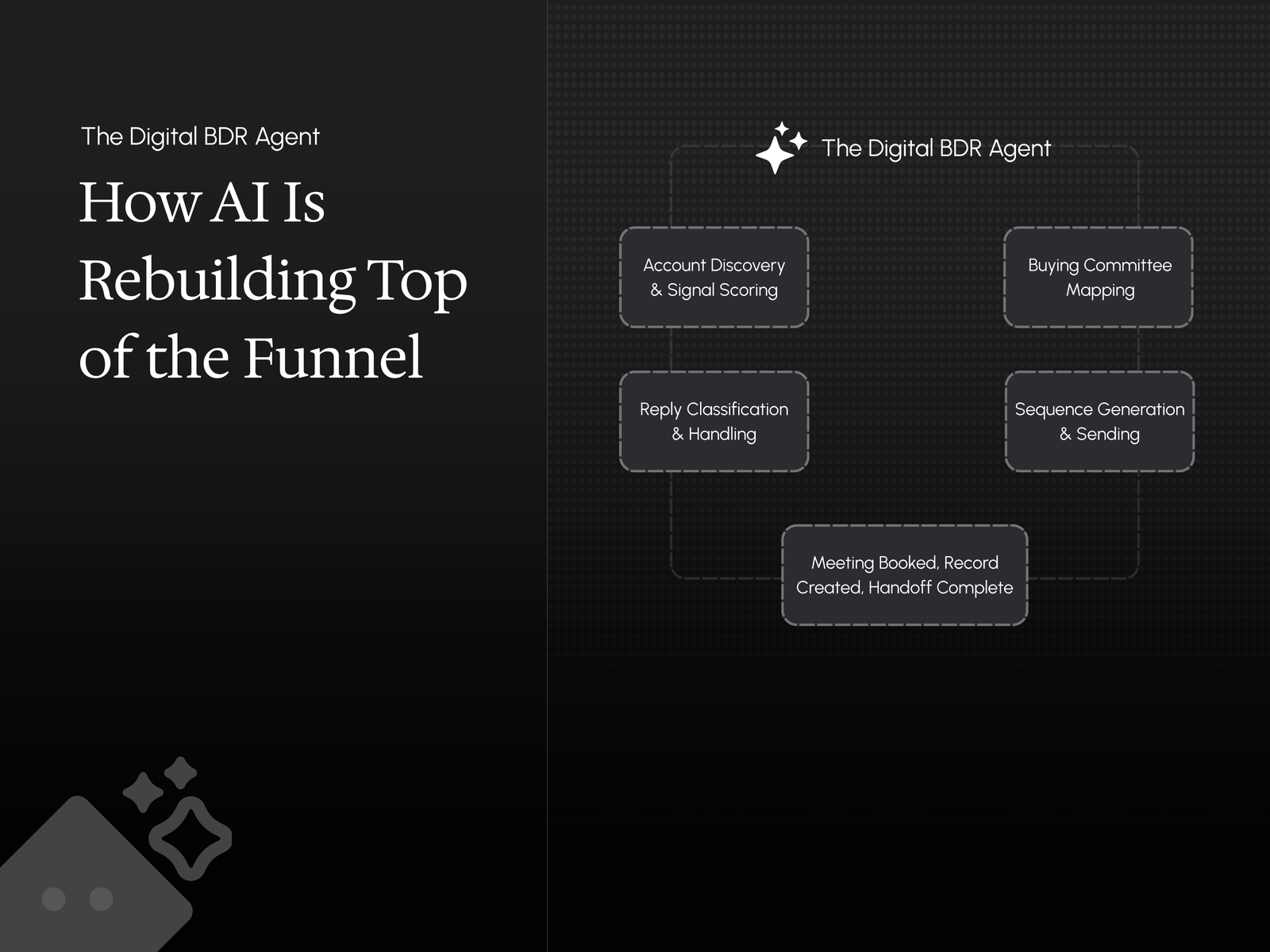
Here is the full workflow, from first signal to booked meeting.
Step One: Account Discovery and Signal Scoring
The agent starts with the ICP criteria and signal sources it has been configured with. It does not build a list of accounts that match the firmographic profile and treat them all equally. It scores each account against two dimensions simultaneously: fit and signal.
Fit covers the characteristics that define a good prospect account: company size, industry, growth stage, geography, technology profile, and any other criteria the team has defined as relevant. Signal covers what is happening at the account right now: recent funding activity, new hires in relevant roles, product launches, expansion signals, regulatory changes that create urgency, or any other indicator that the account is in a buying window.
An account with high fit and active buying signals is prioritised. An account with high fit and no current signals is deprioritised, not excluded, but not at the top of this week’s focus. An account with weak fit is suppressed regardless of signal.
This continuous scoring means the agent is always working the accounts most likely to convert right now, not the accounts that looked good when the list was built three months ago.
Step Two: Buying Committee Mapping
Within each prioritised account, the agent does not stop at finding one contact. It maps the buying committee.
The standard in enterprise B2B is three or more contacts per account covering different roles and seniority levels. A champion who will use the product internally. An economic buyer who controls the budget. An influencer who shapes the evaluation criteria. A technical evaluator who assesses the integration. Each of these roles exists in a real buying committee, and outreach that reaches only one of them is fragile in ways that become visible at the worst possible moment.
The agent identifies the right contacts for each role, verifies their email and mobile data before any message is sent, and builds a coordinated outreach plan that reaches the buying committee in the right sequence, with the right message for each role.
Step Three: Personalised Sequence Generation and Sending
With the account prioritised and the contacts identified, the agent generates personalised sequences for each contact. Personalised means specific to this contact, at this account, based on what the signal data says about why this account is relevant right now and what the contact role means for how the value proposition should be framed.
The sequences are reviewed and approved by a human before they go out. This is the primary Human in the Loop checkpoint for the Digital BDR Agent. A rep or a manager reviews the copy, approves or edits, and the agent sends. The approval process is fast because the agent has done the research and the drafting. The human judgment is applied to the output, not spent producing it.
Once approved, the sequences run across the configured channels: email, and where the team has set it up, other channels. The agent monitors sending caps, enforces the suppression and DNC lists before every send, and adjusts cadence based on engagement signals from each contact.
Step Four: Reply Classification and Handling
This is where the Digital BDR Agent separates most clearly from a standard automation tool.
When a reply arrives, the agent classifies it into one of five categories: interested, not now, wrong person, unsubscribe, or question. Each classification triggers a different action.
An interested reply triggers the meeting booking workflow. The agent checks calendar availability, confirms a time that works for both parties, and generates a calendar invite with the context the rep needs to walk into the call prepared.
A not now reply triggers a requeue into a future nurture sequence calibrated to the timeframe the prospect indicated. A wrong person reply triggers an update to the contact record and a search for the right person at the same account. An unsubscribe reply triggers immediate removal from all sequences and an update to the suppression list.
A question reply triggers the most nuanced response. The agent checks the question against its confidence threshold using the product FAQ it has been given. If the question is within threshold, it answers directly and continues the sequence. If the question is below threshold, it escalates to a human rather than attempting an answer that might be incorrect. Questions about pricing, legal terms, or product roadmap are always escalated, regardless of confidence.
This classification and routing happens automatically, for every reply, at any time of day, with a response time measured in minutes rather than the hours or days it takes in a human-managed inbox.
Step Five: Meeting Booked, Record Created, Handoff Complete
When a meeting is booked, the Digital BDR Agent creates the calendar invite for both the prospect and the rep, writes the CRM contact and lead record with everything it has learned about the account and the contact during the prospecting process, and logs the full sequence history so the rep walking into the call has complete context on every touchpoint.
This is not just administrative tidiness. The record the Digital BDR Agent creates is the foundation that the Digital Sales Agent picks up from. The pre-call brief, the buying committee map, the sequence history, the reply classification, all of it is in the same record, in the same data model, updated in real time. The handoff between prospecting and selling is not a data transfer between two systems. It is a continuation of the same record.
What This Changes for the Sales Team
The most immediate change is time. A human BDR who was spending the majority of their day on research, list building, sequence management, and CRM updates now has that time back. What they spend it on is the work that actually requires their capability: reviewing and refining the sequences the agent drafts, handling the complex replies that need human judgment, managing the relationships with strategic accounts that warrant a more personal touch, and coaching the agent on edge cases where its classifications need calibration.
Industry research consistently shows that implementing agentic AI in even one core sales workflow frees up a meaningful portion of seller time each week. For a BDR whose day was previously structured around the manual workflow the Digital BDR Agent now owns, the recovered time is significantly more than that baseline figure.
The second change is coverage. A human BDR working at full capacity covers a defined territory with a defined cadence. The Digital BDR Agent covers the same territory continuously, adjusting priorities as signals change, adding new accounts as they enter the buying window, and maintaining engagement with accounts that are not ready yet without consuming rep attention. The pipeline it builds is not limited by the number of hours in a working day.
The third change is quality. Because the agent scores accounts against fit and signal simultaneously, the meetings it books are better qualified than the meetings a high-volume manual process produces. The rep walks into a call with a prospect whose account scored well on both dimensions, whose buying committee has been mapped, and whose reply to the sequence indicated genuine interest. The conversion rate from booked meeting to qualified opportunity improves because the upstream quality filter is more rigorous than a human team running at speed can consistently maintain.
The Human BDR in an Agentic World
It is worth being direct about what the Digital BDR Agent does not replace.
Digital BDR Agents do not eliminate BDR roles. They redefine them. Human BDRs in this model focus on complex accounts, strategic outreach, and agent oversight. They become the quality layer that ensures AI-generated pipeline meets the bar for enterprise conversations.
The accounts that require senior relationship management, that have political complexity the agent cannot read from public signals, that need executive-to-executive engagement before a formal evaluation begins: these are the accounts where the human BDR’s capability is most valuable and most differentiated.
The agent handles the volume. The human handles the nuance. The combination produces a pipeline that neither could build alone.
Frequently Asked Questions About the Digital BDR Agent
What is the difference between a Digital BDR Agent and a standard email sequencing tool?
A sequencing tool executes the steps a human defined in advance. A Digital BDR Agent makes decisions: which accounts to prioritise, which contacts to include, how to classify a reply, whether a question is within its confidence threshold. The agent adapts to what it learns. A sequencing tool does not.
Does the Digital BDR Agent replace human BDRs?
No. It takes on the tasks that do not require human judgment, freeing human BDRs to focus on the work that does. Strategic accounts, complex replies, relationship management with senior stakeholders, and oversight of the agent itself are all human responsibilities.
How does the agent handle compliance requirements?
The Digital BDR Agent enforces suppression and DNC lists before every send, maintains sending caps to protect domain health, and escalates any questions about pricing, legal terms, or roadmap rather than answering them autonomously. Unsubscribe requests are processed immediately and the contact is added to the suppression list.
What happens when the agent books a meeting?
The agent generates a calendar invite for both the prospect and the rep, creates the CRM contact and lead record with the full account and sequence history, and logs all context the rep needs for the call. This record becomes the foundation for the Digital Sales Agent to build the pre-call brief from.
What does the human approve before sequences go out?
All sequence copy is reviewed and approved by a human before the agent sends. Any outreach to named or strategically important accounts requires explicit approval regardless of the standard workflow. This is the primary Human in the Loop checkpoint.
Agent Q Digital BDR Agent is one of five specialised agents inside the Quantum Heaps Unified Revenue Engine. It owns your top-of-funnel end to end, from account discovery to booked meeting, while your team focuses on the conversations that close. See how Agent Q works | View pricing