
The meeting is booked. The prospect is interested. The calendar invite is confirmed for Thursday at two.
What happens next determines whether this becomes a closed deal or another opportunity that quietly slips out of the quarter.
In most B2B sales organisations, what happens next looks something like this. The rep spends twenty minutes on Tuesday pulling together background on the company. They check the CRM for prior notes, read a few recent news items about the account, and try to reconstruct what was said in the initial outreach. They build a rough prep document. They join the call, take notes on a notepad or in a separate document, and try to listen and write simultaneously.
After the call, they spend another thirty to forty minutes writing up the summary, updating the CRM fields, scoring the deal against the qualification framework, drafting the follow-up email, and setting the next step task. By the time all of that is done, an hour has passed and three other deals have been sitting without attention.
This happens for every call, for every rep, every day. The research time, the note-taking, the post-call administration: in aggregate, it is one of the largest consumers of selling time in a B2B sales organisation. And almost none of it requires the judgment of an experienced sales professional. It requires time, consistency, and access to information.
These are exactly the conditions where a Digital Sales Agent changes the equation entirely.
What the Digital Sales Agent Is
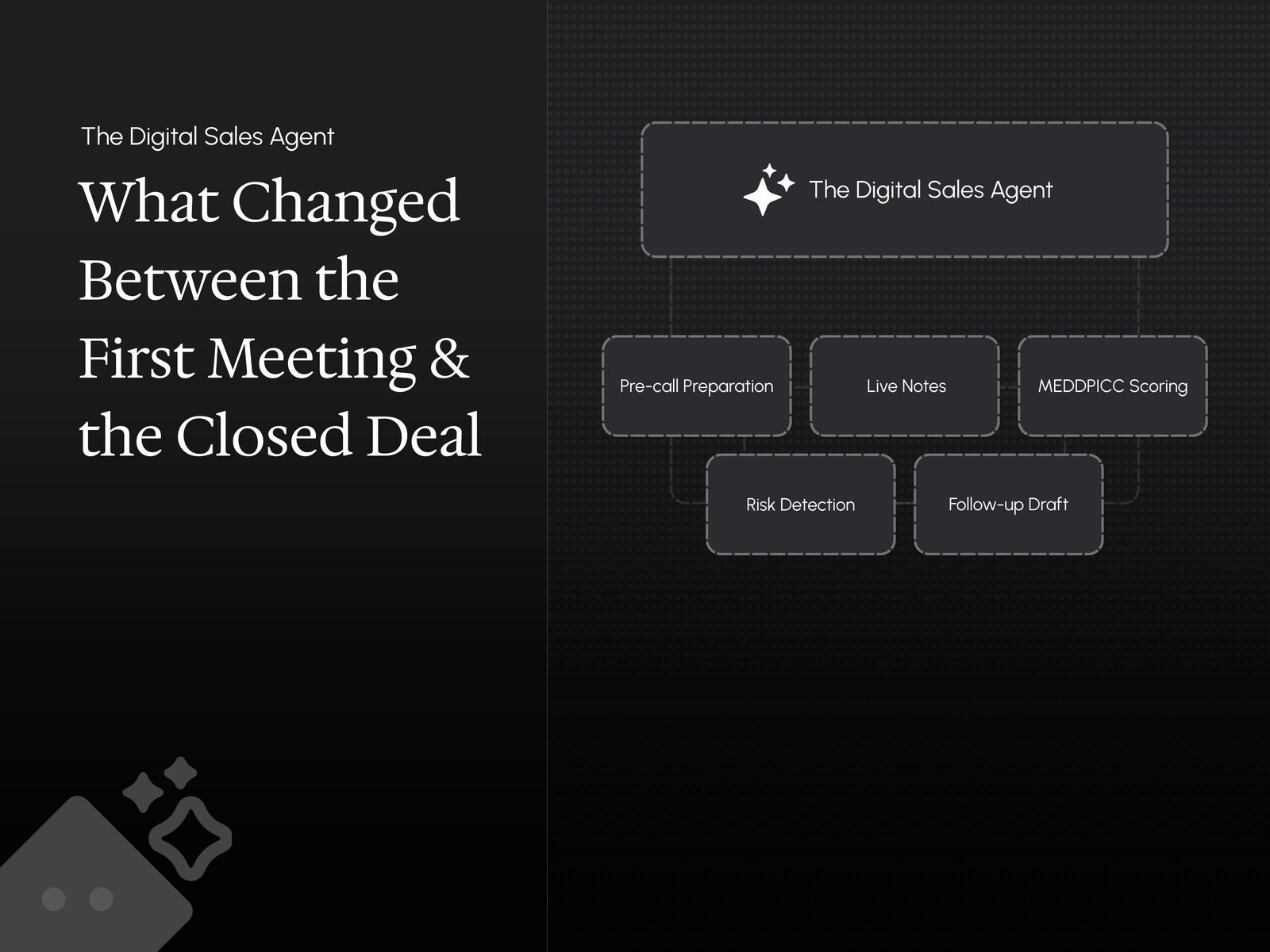
The Digital Sales Agent is a specialised AI agent that owns the active deal process. It is not a co-pilot that waits to be asked for help. It is not a transcription tool that records calls and makes them searchable. It is an autonomous system that prepares every call before it happens, attends every call as an active participant, analyses what was said after the call ends, and produces everything the rep needs to advance the deal without manual effort.
Its job is measured in deal velocity: how quickly deals move through each stage, what percentage of active opportunities have a confirmed next step at all times, and how completely the MEDDPICC qualification framework is filled for every deal in the pipeline.
These three metrics are connected. Deals that are thoroughly qualified move faster. Deals that always have a confirmed next step do not stall. Deals where the rep walks into every call fully prepared make better use of the prospect time that is always scarcer than the rep would like.
The Digital Sales Agent addresses all three simultaneously.
What Happens Before the Call
The most underestimated part of a sales agent capability is what it does before anyone joins a meeting.
A pre-call brief prepared by a human rep is inevitably shaped by whatever information the rep can pull together in the twenty minutes between their last call and this one. It is usually adequate. It is rarely comprehensive. And it almost never includes a structured analysis of what is still unknown about the deal, which gaps in the qualification record need to be addressed in this specific conversation, or which discovery questions would be most useful given what has been confirmed so far.
The pre-call brief the Digital Sales Agent produces is a different document entirely.
It starts with the pain hypothesis: based on everything known about this account, this contact, and this deal, what is the most likely reason this prospect is evaluating a new solution right now? It maps the organisational chart of everyone known to be involved in the evaluation, flagging gaps in the buying committee where key roles have not yet been identified. It surfaces the account tech stack based on available signals, giving the rep relevant context about the environment the prospect is working in. It pulls every prior touchpoint into a timeline: what was said, what was sent, what the prospect responded to and what they did not.
It then generates a set of discovery questions calibrated specifically to this call. Not generic discovery questions from a playbook. Questions designed to address the specific gaps in the qualification record that exist right now, in this deal, at this stage.
By the time the rep joins the call, they have a complete situational picture that would have taken forty-five minutes to assemble manually. It was ready before they sat down.
What Happens During the Call
The Digital Sales Agent joins every call as a notetaker. This is not a passive function.
While the call is in progress, the agent is listening for specific signals. It tracks which MEDDPICC criteria are being addressed and which are still unconfirmed. It monitors whether the economic buyer is present or absent from the conversation. It listens for competitive mentions, risk signals, and changes in the prospect tone that suggest the deal dynamics are shifting. It tracks whether a compelling event has been confirmed or is still assumed.
All of this happens in the background. The rep is free to be present in the conversation, to listen actively, to adapt to what the prospect is saying, to exercise the judgment and relationship intelligence that no AI system can replicate. The agent is doing the observation work so the rep does not have to split their attention between listening and capturing.
This separation of roles is not just a convenience. It is a structural improvement in call quality. Research across B2B sales organisations in 2026 consistently finds that reps who are freed from note-taking during calls make better use of the time and produce stronger outcomes. The conversations go deeper. The questions are more precise. The prospect feels more heard. All of this is downstream of the rep being able to give the conversation their full attention.
Recording consent is captured before every call the agent joins. This is not a configurable option. It is a hardcoded requirement that cannot be bypassed.
What Happens After the Call
This is where the Digital Sales Agent produces its most tangible impact on deal velocity.
Within minutes of the call ending, the agent has completed five tasks that would otherwise consume between thirty and sixty minutes of the rep time.
The first is a call summary: a structured account of what was discussed, what was confirmed, what was raised as a concern, and what the prospect committed to as a next step. Not a transcript. A structured summary organised by the elements that matter for advancing the deal.
The second is the MEDDPICC scorecard. Every criterion in the qualification framework is scored based on evidence from the call transcript. Each score includes a citation: the specific moment in the call where that criterion was confirmed or where its absence was identified. A score of incomplete does not mean the deal is weak. It means the qualification gap is known, documented, and addressable in the next interaction. A criterion that is marked as assumed without evidence is flagged differently from one that has been explicitly confirmed. The distinction matters because the deals that slip out of quarters are almost always the ones where assumptions were treated as confirmations.
The third is risk detection. The agent reads the call for signals that the deal carries elevated risk: single-threading, where the relationship depends on one contact without broader stakeholder coverage; stall signals, where the language of urgency has faded and the decision timeline has become vague; competitive signals, where a rival product or approach has entered the conversation. These risks are surfaced immediately, not in the next pipeline review.
The fourth is the follow-up email draft. Written in the rep voice, referencing the specific points discussed, confirming the next step, and including any relevant content or materials that would advance the conversation. The rep reads it, edits where needed, and sends. The writing time is gone.
The fifth is the mutual action plan and next step task. A documented shared plan that gives both the rep and the prospect visibility into what needs to happen between now and the close, with a specific next step entered as a task in the CRM before the rep has closed the call window.
Every CRM write the agent makes is confirmed by the rep before it saves. No field is overwritten without approval. Every MEDDPICC score cites its source. The agent does not assert. It evidences.
What This Changes for Deal Velocity
Deal velocity is the output metric of everything above working correctly. And it is the metric that the Digital Sales Agent moves most directly.
Deals stall for three consistent reasons in B2B sales. They stall because the qualification gaps that would have predicted the stall were never identified clearly enough to address. They stall because the rep did not have a confirmed next step and the deal drifted without structure. And they stall because the risk signals that appeared in the conversation data were not surfaced until the pipeline review, by which point the window to intervene had closed.
The Digital Sales Agent addresses all three causes simultaneously. Qualification gaps are identified immediately after each call and carried into the prep for the next one. A confirmed next step is a mandatory output of every call summary. Risk signals are surfaced in the same session where they appear, not a week later.
The compounding effect of these three interventions on deal velocity is measurable. Across B2B sales organisations deploying agentic AI in the active deal workflow in 2026, deal cycle time reductions of between 30 and 50 percent are consistently reported when the agent is running on clean, unified data rather than being layered on top of a fragmented stack. The reason this distinction matters is important: an agent that reads from a synchronised copy of the CRM is working with yesterday data. An agent that reads from the live deal record is working with what is true right now.
This is why the Digital Sales Agent inside Agent Q operates on the same unified data model as every other part of the Quantum Heaps platform. The pre-call brief is built from the live record. The MEDDPICC scorecard writes back to the live record. The follow-up email references the live conversation history. There is no version drift between what the agent reads and what the deal actually looks like.
The Rep Experience
It is worth describing what a working day looks like for a rep whose pipeline is running on the Digital Sales Agent.
Monday morning: the agent has generated a weekly digest of every active deal, highlighting the ones that need attention this week, the qualification gaps that were identified last week and not yet addressed, and the deals where risk signals appeared in recent calls.
Before each call: a pre-call brief is waiting in the deal record. The rep reads it on the way to the meeting. They are prepared in a way that would have taken forty-five minutes to achieve manually.
During each call: the rep is fully present. They are not writing notes. They are listening and responding.
After each call: the summary, the MEDDPICC scorecard, the follow-up draft, and the next step task are all waiting for review and approval. The rep spends ten minutes reviewing and approving rather than forty-five minutes creating. They move to the next deal.
By the end of the day, every deal in the pipeline has been touched, every next step is confirmed, and every risk signal that appeared in any call that day has been surfaced and noted. The CRM reflects the actual state of every deal because the agent updated it from the call transcript rather than relying on the rep to remember and enter.
The rep who previously spent two to three hours per day on post-call administration has that time back. The research across B2B sales organisations in 2026 is consistent: deploying agentic AI in the active deal workflow cuts administrative time by between 34 and 50 percent for reps who fully adopt it. That time returns to selling.
What the Human Owns
The Digital Sales Agent does not close deals. It is important to be direct about this.
The relationship with the prospect belongs to the rep. The strategic decisions about how to position, when to push, when to pause, and how to handle the moment in a negotiation where the deal could go either way: these require human judgment, human empathy, and human experience that no AI system in 2026 replicates reliably.
What the agent removes is the administrative cost of running those human conversations at scale. The prep that used to consume a morning. The notes that used to compete with listening. The post-call work that used to eat the afternoon. All of it done, accurately and consistently, so the human can do what humans actually do best.
The most effective sales organisations in 2026 are not the ones that have replaced their reps with agents. They are the ones that have given their reps agents, so that the rep hours that were previously spent on work a machine does better are now spent on the conversations that only a human can have.
Frequently Asked Questions About the Digital BDR Agent
What is a Digital Sales Agent?
A Digital Sales Agent is a specialised AI agent that owns the active deal process in a B2B sales organisation. It prepares reps before every call, attends every call as a notetaker, scores the deal qualification framework with evidence from the transcript, detects deal risk and stall signals, drafts the follow-up email, and updates the CRM with the next step, all without requiring the rep to spend time on any of these tasks manually.
How does the Digital Sales Agent score MEDDPICC?
The agent reads the call transcript and matches the content against each MEDDPICC criterion: Metrics, Economic Buyer, Decision Criteria, Decision Process, Identified Pain, Champion, and Competition. Each criterion is scored based on what was explicitly confirmed in the conversation, with a citation to the specific moment in the transcript where the evidence appears. Criteria that are assumed rather than confirmed are flagged differently. The rep reviews every score before it is written to the CRM.
Does the Digital Sales Agent replace the sales rep?
No. The agent handles the preparation, documentation, qualification scoring, risk detection, and drafting work that consumes a significant fraction of a rep working day. The rep handles the conversations, the relationships, the strategic decisions, and the human judgment calls that determine whether deals close. Every CRM write the agent makes requires rep approval before it saves.
What happens if the agent detects deal risk?
Risk signals identified during the call, including single-threading, stall language, unconfirmed economic buyer presence, or competitive mentions, are surfaced immediately in the call summary and flagged in the deal record. The rep and manager see them the same day they appear, not at the next pipeline review. This advance warning gives enough time to intervene, reassign, or adjust the forecast before the risk becomes a loss.
How does the Digital Sales Agent handle recording consent?
Recording consent is captured before every call the agent joins. This is a hardcoded requirement built into the agent operating parameters and cannot be bypassed or configured away. It is not a setting. It is a guardrail.
What is the primary measure of success for the Digital Sales Agent?
Deal velocity: specifically, how long deals spend in each stage, what percentage of active opportunities have a confirmed next step at all times, and how completely the MEDDPICC qualification framework is filled across the active pipeline. These three metrics are tracked continuously and available in the revenue leader dashboard without requiring a manual report.
The Digital Sales Agent is the second of five specialised agents inside the Quantum Heaps Unified Revenue Engine. It picks up where the Digital BDR Agent leaves off, owning the deal from the first meeting to the close plan, so your reps can spend their time on the conversations that only humans can have. See how Agent Q works | View pricing