
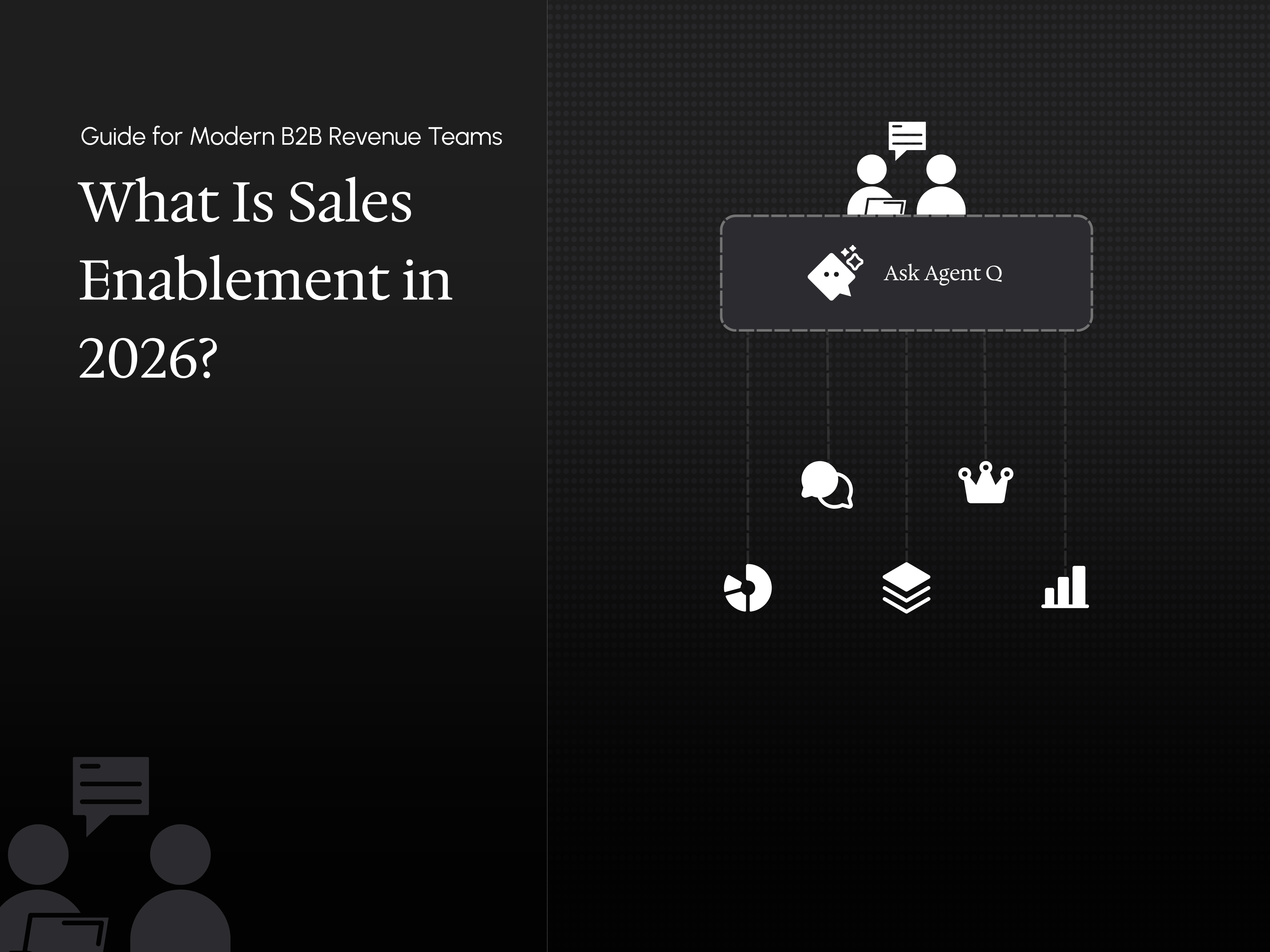
There is a moment every sales leader recognizes. A rep is on a late-stage call with a high-value prospect. The buyer raises a competitive objection the rep has heard before, but cannot answer clearly in the moment. Somewhere inside the company there is probably a battle card for this exact situation. Marketing may have created it three months ago. Enablement may have uploaded it into a portal. Product marketing may even have announced it in Slack. But the rep cannot find it when it matters. The call ends. The deal slows down. Two weeks later it slips out of the quarter. This is the reality of sales enablement at most B2B companies today.
The problem is rarely that teams lack content, training, or coaching. The problem is that enablement exists as a disconnected function rather than an operational system embedded into the actual revenue workflow.
In 2026, the companies winning consistently are treating enablement differently. They are no longer running enablement as a collection of onboarding decks, LMS modules, and forgotten content folders. They are building AI-native enablement directly into the way their revenue teams sell.
This guide explains what modern sales enablement actually is, why most enablement programmes fail, and what high-performing revenue teams are doing differently.
What Is Sales Enablement?
Sales enablement is the process of giving revenue teams the content, intelligence, coaching, and operational support they need to close deals more effectively. At its core, enablement exists to answer one question:
How do we help reps perform at a consistently high level across every stage of the revenue cycle?
Traditionally, sales enablement included:
- Onboarding and ramp programmes
- Product training
- Competitive battle cards
- Pitch decks and case studies
- Sales playbooks
- Objection handling frameworks
- Coaching and certification programs
All of these still matter. But in 2026, enablement has expanded far beyond training.
Modern enablement now sits at the intersection of:
- Revenue Operations
- AI-driven coaching
- CRM intelligence
- Forecasting systems
- Real-time deal guidance
- Conversation intelligence
- Performance analytics
The best enablement teams today are not simply creating content. They are influencing forecast accuracy, win rates, sales velocity, and rep productivity at scale.
Why Traditional Sales Enablement Is Breaking Down
For years, enablement was treated as a support function rather than a revenue-critical system. The result is a model that looks good operationally but fails commercially.
Companies have:
- Thousands of enablement assets that reps rarely open
- LMS platforms with low engagement after onboarding
- Coaching that depends entirely on manager bandwidth
- Content libraries disconnected from live opportunities
- Certifications that measure completion rather than selling effectiveness
Most enablement teams are creating more content every quarter while reps are using less of it. The reason is simple. Enablement in most organizations is still built around the assumption that reps will proactively search for help.
In reality, sellers operate in highly compressed environments. They are juggling pipeline reviews, prospecting, follow-ups, procurement discussions, forecasting updates, and internal meetings simultaneously. They do not have time to stop in the middle of a live deal and search through folders for the right content.
The operational gap is enormous. The content exists. The context does not.
The Five Biggest Problems in Sales Enablement Today
Problem 1: Reps Cannot Find the Right Content When They Need It
Most enablement systems are organized like storage libraries, not execution systems. Content lives in folders categorized by product line, campaign, region, or asset type. But buyers do not buy according to your folder structure. What reps actually need is situational enablement. A rep in a late-stage security review against an incumbent competitor needs completely different support than a rep handling pricing objections in an early discovery call. Traditional enablement platforms force reps to search manually for what they need. Modern enablement systems surface content automatically inside the deal workflow itself. The difference is operationally massive. The highest-performing revenue teams now use AI systems that understand:
- The current stage of the deal
- The industry of the buyer
- Competitive signals mentioned in calls
- Stakeholders involved in the opportunity
- Historical win patterns for similar deals
The platform then surfaces the exact battle card, case study, pricing framework, or objection-handling guidance relevant to that specific moment. The rep does not search. The system delivers the right enablement at the exact moment it is needed inside the workflow itself. This is the shift companies like Quantum Heaps are building toward with AI-native enablement: right content, right deal, one click.
Problem 2: Coaching Happens Too Late
Most sales coaching is retrospective. Managers review calls after deals are lost. Reps receive feedback after the quarter is over. Enablement identifies skill gaps only after performance declines become visible in the numbers. By then, the revenue impact has already happened. The problem is not effort. The problem is scale.
A frontline sales manager with eight to twelve reps cannot manually review every call, every objection pattern, and every stage transition across an entire quarter. AI-driven enablement changes this.
Modern enablement systems powered by conversational intelligence and revenue context can identify behavioral gaps automatically across calls, emails, and pipeline activity without managers manually reviewing every interaction. Modern enablement systems analyze live conversations automatically and identify behavioral patterns in real time:
- Which reps consistently fail to multithread deals
- Which objections appear most frequently
- Which discovery questions top performers ask differently
- Which competitors are winning in specific segments
- Which reps are speaking too much during calls
This allows coaching to happen continuously rather than retrospectively. The best enablement teams in 2026 are not running quarterly training sessions. They are operating always-on coaching systems.
Problem 3: Ramp Time Takes Too Long
Ramp time remains one of the most expensive problems in B2B sales. Every month a new rep spends below productivity target represents lost pipeline, missed quota attainment, and delayed revenue contribution. Traditional onboarding programs focus heavily on knowledge transfer:
- Product information
- Internal process documentation
- Sales methodology training
- CRM workflows
But knowledge alone does not create selling effectiveness. The fastest-ramping sales organizations now focus on behavioral replication. Instead of static onboarding paths disconnected from live selling environments, AI-native enablement systems expose new reps to the exact behaviors, conversations, and deal patterns driving successful outcomes across the organization. Instead of simply teaching new reps what the company sells, they expose them to:
- Real winning calls
- Actual objection-handling examples
- Successful discovery frameworks
- High-performing deal progression patterns
- AI-generated summaries of top rep behaviour
The result is that new reps learn operational selling patterns much faster. Enablement is becoming less about static training and more about continuous exposure to successful execution.
Problem 4: Enablement Metrics Do Not Connect to Revenue
One of the biggest structural issues in enablement is measurement. Most enablement teams still report metrics like:
- Content views
- Certification completion
- Training attendance
- LMS engagement
None of these are revenue outcomes. A rep can complete every certification module and still miss quota. Modern enablement leaders are now measured differently. The metrics that matter in 2026 are:
- Ramp time reduction
- Win rate improvement
- Sales cycle compression
- Forecast accuracy impact
- Rep attainment improvement
- Deal-stage conversion rates
- Content influence on closed revenue
This shift changes how enablement teams operate. They stop optimizing for content production volume and start optimizing for measurable selling effectiveness.
Problem 5: Enablement Is Disconnected From the Revenue Stack
This is the foundational issue underneath almost every other enablement problem. Most companies run enablement on separate systems disconnected from the CRM, forecasting layer, and deal intelligence platform. The result is fragmentation. The CRM knows what stage the deal is in. The conversation intelligence tool knows what objections appeared during the call. The enablement platform contains the relevant battle card. But none of these systems operate on a shared data model.
So the rep still has to manually connect everything themselves. This is why fragmented enablement rarely scales.
The future of enablement is unified revenue intelligence where coaching, content, forecasting, CRM activity, prospect engagement signals, and deal guidance operate together inside one connected system.
This is increasingly why modern revenue teams are moving away from disconnected enablement portals toward AI-native Revenue OS platforms where enablement is embedded directly into the operational workflow rather than layered on top of it.
What High-Performing Enablement Teams Are Doing Differently
The enablement teams producing measurable revenue impact in 2026 share several operational characteristics.
They Treat Enablement as Revenue Infrastructure
The strongest enablement leaders no longer position themselves as internal trainers. They operate as revenue performance architects. Their responsibility is not simply to teach reps. It is to improve:
- Win rates
- Forecast confidence
- Sales velocity
- Rep productivity
- Ramp efficiency
- Pipeline progression
That changes how they priorities everything. Content is no longer created because someone requested a deck. It is created because a measurable revenue problem exists.
They Build Enablement Into the Workflow
High-performing enablement does not require reps to leave the workflow. The strongest enablement systems operate as overlays inside the existing selling motion rather than separate destinations reps need to remember to open. The guidance appears where the work happens:
- Inside the CRM
- During pipeline reviews
- During live calls
- Inside forecast updates
- During opportunity progression
This dramatically increases adoption. Reps use enablement when it helps them close deals immediately. Not when it feels like additional administrative work.
They Use AI to Scale Coaching
AI has become operationally valuable in enablement for one specific reason: It scales observational coaching.
The system can analyse thousands of calls, identify behavioural patterns, compare top performers against underperformers, and surface coaching recommendations automatically. This allows managers to focus on actual coaching conversations rather than spending hours reviewing recordings manually. AI is not replacing enablement leaders. It is amplifying their ability to identify what matters.
They Align Enablement With RevOps
Enablement and Revenue Operations are increasingly merging operationally. Because the same systems that drive forecasting, pipeline visibility, and CRM intelligence also provide the context required for effective coaching and content delivery. The strongest B2B organizations now operate enablement and RevOps as connected functions rather than separate departments.
This alignment creates something most companies still lack: A unified operational view of how reps actually sell.
The Shift From Content Libraries to AI-Native Enablement
The enablement technology market has fundamentally changed over the last three years. Traditional enablement platforms focused primarily on content management:
- Storing battle cards
- Hosting certifications
- Managing onboarding modules
- Tracking training completion
But modern enablement requires much more than storage. Revenue teams now need systems that can:
- Analyse conversations automatically
- Surface deal-specific guidance in real time
- Detect skill gaps early
- Recommend coaching actions
- Validate forecasting confidence
- Track competitive trends across deals
- Connect enablement activity directly to revenue outcomes
This is where AI-native enablement platforms are creating a structural advantage. Because the intelligence layer is embedded directly into the revenue workflow itself.
Instead of forcing reps to search manually for battle cards, case studies, coaching notes, or competitive positioning, the platform surfaces contextual enablement automatically based on the actual state of the opportunity. The system understands:
- What is happening inside the deal
- Which behaviours correlate with wins
- Which risks are emerging
- Which enablement assets influence progression
- Which reps require intervention
That intelligence becomes operationally powerful because it happens continuously, not quarterly.
What Sales Leaders Should Look for in an Enablement Platform in 2026
If you are evaluating sales enablement technology today, the most important question is no longer: How many assets can this platform store?
The real question is: Can this platform improve selling behavior at scale?
Here is what modern revenue teams should prioritise.
1. Real-Time Contextual Guidance
Modern enablement should feel proactive rather than searchable. Enablement should appear inside the workflow automatically. If reps still need to manually search for content, adoption will remain low regardless of how much content exists. Look for systems that surface:
- Battle cards by competitor mention
- Objection guidance during live opportunities
- Stage-specific coaching recommendations
- Relevant case studies based on industry and deal size
2. AI-Powered Conversation Intelligence
The future of enablement is behavioral analysis. The platform should analyze calls automatically and surface patterns around:
- Discovery effectiveness
- Stakeholder engagement
- Objection handling
- Talk-to-listen ratio
- Competitive mentions
- Risk indicators
Without requiring managers to review every recording manually.
3. Unified Revenue Data
Enablement cannot operate effectively on isolated systems. The platform should connect directly with:
- CRM activity
- Forecasting systems
- Pipeline stages
- Commission visibility
- Deal progression data
This shared data model is what allows enablement to become operationally intelligent rather than administratively useful. Without unified revenue data, AI enablement becomes fragmented recommendation software. With a shared operational model, enablement becomes revenue intelligence.
4. Measurable Revenue Impact
The platform should connect enablement activity directly to revenue outcomes. Sales leaders should be able to answer questions like:
- Which enablement assets influence win rates?
- Which coaching patterns improve stage conversion?
- Which onboarding programmes reduce ramp time?
- Which behaviours correlate most strongly with quota attainment?
If enablement reporting stops at content engagement metrics, the system is incomplete.
5. Low Administrative Burden
The highest-performing revenue systems reduce work for reps rather than adding to it. Enablement adoption improves dramatically when:
- CRM activity updates automatically
- Calls are summarised by AI
- Coaching insights are generated automatically
- Guidance is surfaced proactively
Reps adopt systems that help them sell. They avoid systems that increase operational friction.
How AI Is Reshaping Sales Enablement
Artificial intelligence is affecting enablement in a more meaningful way than almost any other part of the revenue stack. But the value is highly specific. Where AI is delivering real enablement impact in 2026:
Call analysis at scale. AI can analyse thousands of sales conversations and identify patterns human managers would never have time to uncover manually.
Behavioural coaching. AI can detect specific rep behaviours correlated with higher win rates and surface targeted coaching recommendations.
Contextual content delivery. AI can understand the state of a deal and surface relevant guidance automatically.
Ramp acceleration. AI can expose new reps to winning patterns faster through summarised call insights, successful deal analysis, and real examples from top performers.
Forecast validation. Enablement now contributes directly to forecasting accuracy because AI can identify behavioural indicators of deal risk earlier.
Where AI is not replacing human leadership:
- Relationship-building
- Strategic negotiation
- Team culture
- Executive communication
- Leadership judgment
- Complex enterprise selling decisions
The companies succeeding with AI enablement are using it to reduce friction, improve visibility, and scale coaching not replace human sales leadership.
The Future of Revenue Enablement
The distinction between enablement, RevOps, CRM, forecasting, and revenue intelligence is beginning to disappear. All of these functions are converging around one operational reality: Revenue teams perform best when the system around them actively helps them execute.
The next generation of enablement is not a standalone content portal. It is an embedded revenue execution layer operating continuously across pipeline activity, prospect engagement, forecasting signals, coaching patterns, and deal progression.
It is an AI-native revenue operating system that:
- Understands every deal in real time
- Surfaces the right guidance automatically
- Coaches reps continuously
- Validates forecasting signals
- Tracks behavioural patterns across the organisation
- Connects enablement directly to revenue outcomes
This is the direction high-performing B2B revenue teams are already moving toward. And the performance gap between companies that operate this way and companies still relying on disconnected tools is widening every quarter.
Frequently Asked Questions About Sales Enablement
What is the primary goal of sales enablement?
The primary goal of sales enablement is to improve seller effectiveness. That includes helping reps close deals faster, improve win rates, reduce ramp time, handle objections more effectively, and operate with greater consistency across the revenue cycle.
What is the difference between sales enablement and sales training?
Sales training is one component of sales enablement. Training focuses on knowledge transfer and skill development. Sales enablement is broader; it includes coaching, content delivery, CRM intelligence, operational guidance, conversation analysis, and performance optimisation across the full selling workflow.
Why do most sales enablement programs fail?
Most enablement programmes fail because they operate outside the actual sales workflow. Content exists, but reps cannot access it contextually when it matters. Coaching happens too late, adoption remains low, and enablement metrics fail to connect directly to revenue outcomes.
What metrics should enablement teams track?
The most important enablement metrics are revenue-related metrics:
- Win rate improvement
- Ramp time reduction
- Deal-stage conversion rates
- Sales cycle length
- Rep attainment improvement
- Forecast accuracy contribution
- Content influence on closed revenue
Metrics like content views and certification completion are secondary.
How does AI improve sales enablement?
AI improves enablement by scaling behavioral analysis and contextual guidance. It can analyze sales conversations automatically, identify coaching opportunities, surface relevant content during live deals, detect risk signals early, and help reps access the right information without manual searching.
What should companies look for in a modern enablement platform?
Companies should look for platforms that combine enablement, CRM intelligence, forecasting visibility, conversation analysis, and AI-driven coaching inside one connected revenue workflow. The strongest platforms reduce administrative burden while improving visibility, coaching quality, and rep productivity.
Quantum Heaps is an AI-native Revenue OS built for modern B2B revenue teams. Agent Q combines CRM, forecasting, enablement, commissions, and revenue intelligence into one unified platform – helping teams surface the right enablement in the right deal at the right moment. With AI-powered guidance, real-time prospect engagement intelligence, faster rep ramp, and embedded workflow enablement, Quantum Heaps helps revenue teams operate with one connected system instead of fragmented tools. Learn more at Quantum Heaps.