
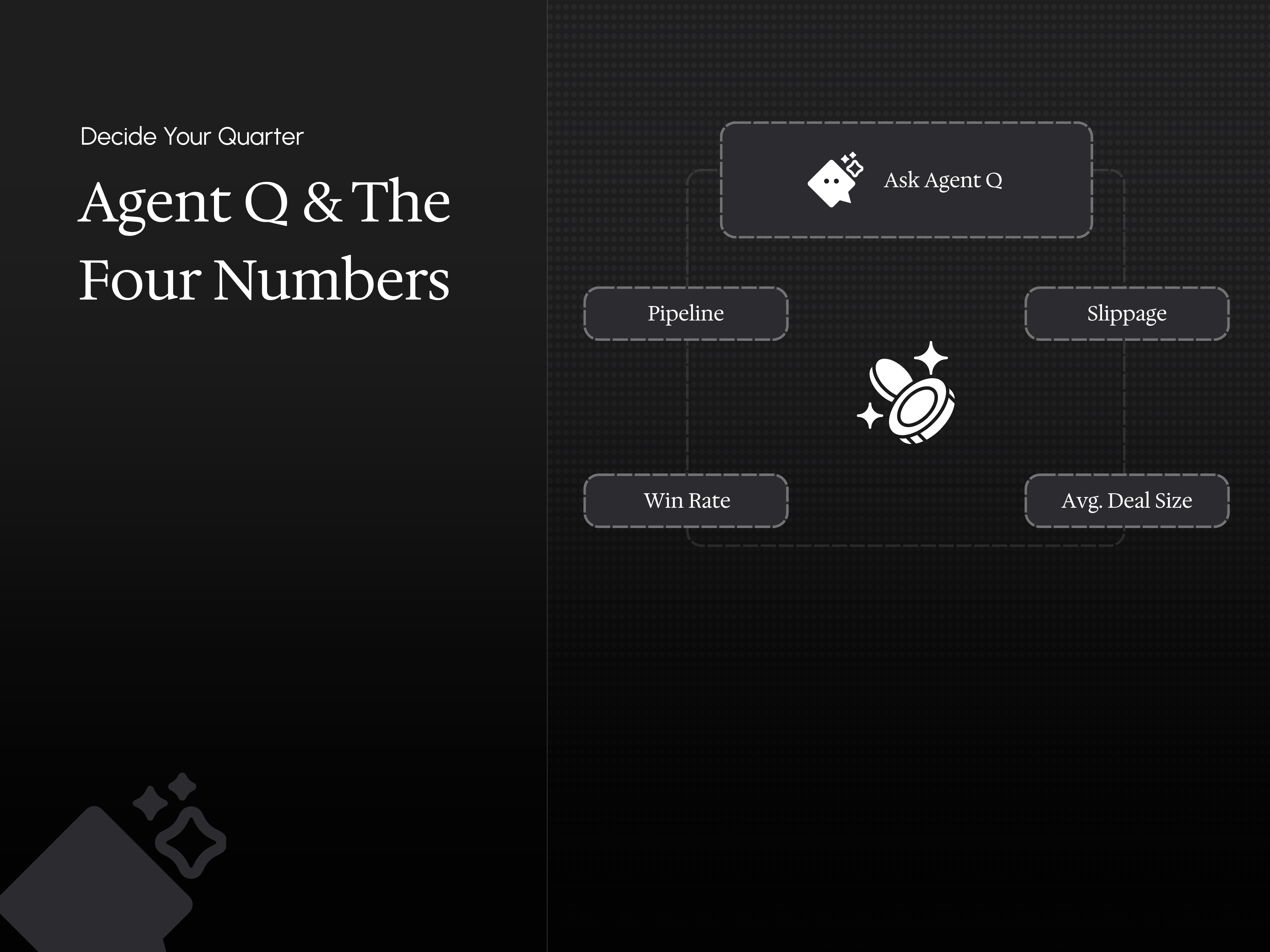
Every revenue number a company reports is the product of four others. Not vision, not culture, not the quality of the deck that went to the board. Four operational variables that multiply together to produce the figure everyone is accountable for at quarter end:
Pipeline × Win rate × Average deal size × (1 − slippage)
Improve any one and revenue moves. Let any one quietly degrade and the whole result caps no matter how hard the team works or how strong the product is.
Most revenue programs don’t underperform because leaders don’t know these levers exist. Every CRO knows the equation. The problem is the system underneath the team, the CRM, the spreadsheets, the bolted-on forecasting tool, the enablement portal nobody opens was built to record these four numbers after the fact. Not to move them while there is still time to act.
That is the gap Agent Q closes, an AI revenue agent that works inside the pipeline, on every deal, every day, not a dashboard reporting last quarter’s miss.
A Tuesday That Doesn’t Become a Slipped Quarter
The four numbers are abstract until you watch them move on one deal.
A rep has a $180K deal in Commit, Stage 4, closing this quarter. On paper it looks healthy. Underneath, three things have quietly gone wrong: the economic buyer has been absent from the last five calls, the champion who used to reply in four hours now takes two days, and the close plan has a security-review step with no owner and no date.
In a Salesforce-plus-Gong-plus-Highspot stack, none of those signals live in the same place, so nobody connects them until the deal slips in the final week and the rep explains it on Monday. With Agent Q, the moment that Commit deal stops behaving like one, the risk surfaces inside the deal record on Tuesday. The manager intervenes before the pipeline review, and the deal closes on time.
That is the whole thesis in one deal. Now the four numbers behind it.
Number One: Pipeline You Can Actually Trust
Most pipeline problems are honesty problems, not coverage problems. A team can show three-times coverage and still miss badly, because half that pipeline was never real: opportunities created to look productive, deals that stalled months ago but were never marked dead, entries logged after one call where the prospect said “sounds interesting” and the rep heard “we’re buying.” Coverage built on optimism forecasts beautifully and converts terribly.
Top-performing teams maintain an average pipeline coverage of 4.1x to consistently beat their targets but they pair it with rigorous qualification. The ratio alone tells you nothing; the quality underneath it tells you everything.
And the quality problem starts at the foundation. After studying 2.5 million sales conversations, research concluded that 40–60% of the average pipeline stalls out due to buyer indecision, not competitive loss. Buyers aren’t choosing a competitor; they’re choosing to do nothing because the risk of change feels greater than the cost of staying still. Most CRM systems can’t distinguish those no-decision deals from the ones that will actually close, because the data underneath them is built on what reps chose to enter, not what actually happened.
At the industry-average CRM adoption rate of 34%, roughly two of every three sales interactions never make it into the system at all. The pipeline becomes a fiction written from memory, optimistic, selective, and increasingly stale.
Agent Q fixes the foundation first. Because it reads every call, email, and calendar entry automatically, the pipeline updates itself from real activity, not from a rep’s end-of-week data entry. Deal stages are validated against objective signals: MEDDPICC completeness, engagement recency, stakeholder presence on calls, and time on stage versus benchmarks for similar deals. A deal that says Stage 3 but has no economic buyer, no meeting in eleven days, and a single thread of contact is flagged for what it is, a pipeline that looks real and isn’t.
When the foundation is honest, everything downstream forecasting, capacity planning, headcount becomes reliable. Build on partial data and the model fails you when you most need it to hold.
Number Two: Win Rate, and the Qualification Discipline That Decides It
Win rate is decided long before the close call at qualification, in the first two or three conversations, when the rep either establishes whether a deal is real and winnable or skips that rigour because the prospect seemed enthusiastic.
67% of lost sales result from inadequate lead qualification, and only 25% of marketing leads actually qualify for direct sales engagement so most reps spend their energy on opportunities that were never going to close, because nobody asked the right questions early enough.
Organisations adopting MEDDPICC achieve 18% higher win rates, 24% larger deals, and 26% shorter sales cycles. It’s not magic, it’s a forcing function: eight checkpoints that force an honest answer to a simple question: is this deal real, and what do we need to do to win it?
The eight elements are an early warning system:
- Metrics – what outcome is the buyer chasing, and can you prove you deliver it?
- Economic Buyer – who signs, and have they been in a conversation yet?
- Decision Criteria – what does the buyer use to evaluate vendors?
- Decision Process – how does this organisation actually buy, and who’s involved?
- Paper Process – what happens after the verbal yes, and how long does it take?
- Identify Pain – what pain drives this, and is it urgent enough to change?
- Champion – who wants you to win, and can they move the organisation?
- Competition – who else is in the deal, and what’s the buyer’s frame for choosing?
A deal that can’t answer all eight is not a late-stage deal, whatever the CRM says it’s an opportunity with at least one unresolved reason it might not close, and the longer that reason goes unaddressed, the more expensive it becomes.
The problem has always been enforcement. Asking reps to self-score MEDDPICC is asking the optimist to grade their own homework. The modern buying committee now runs to an average of 13 decision-makers per deal in 2026 far too many to track in a rep’s head across forty live opportunities.
Agent Q removes the self-reporting. It reads the actual calls, email threads, and transcripts and populates the MEDDPICC picture from evidence rather than intention. It knows whether the economic buyer has appeared on a call or only been mentioned, whether the decision process was discussed or assumed, whether a competitor was named and how the prospect responded, and whether the champion is genuinely engaged or politely stalling because response time, tone, and engagement frequency are signals it reads continuously.
When qualification is scored on what happened rather than what the rep hopes, reps spend their hours on winnable deals and the forecast reflects reality. Teams using MEDDPICC often see win rates rise 15–30% within two quarters. Agent Q delivers that discipline without relying on rep compliance.
Number Three: Average Deal Size, and the Multithreading That Grows It
Deal size is not mainly a pricing decision, it’s a relationship-breadth decision. Single-threaded deals one champion, one contact, one point of entry close small and close slow, when they close at all. Small, because a single stakeholder rarely sees the full scope of the problem. Slow, because when that champion goes on leave or changes roles, the deal goes with them. And they die disproportionately, because a single point of failure in a complex buying organisation is not a relationship, it’s a risk.
The deals that expand are multithreaded: the rep is in conversation with the economic buyer, the user buyer, the technical evaluator, and the executive sponsor. Each new stakeholder surfaces a new use case, a new department, a bigger version of the problem. Growing deal size is the discipline of widening the relationship before you quote.
The reason it doesn’t happen consistently is invisibility. No rep can track stakeholder coverage across forty opportunities; no manager can audit it from selectively entered notes. So single-threading goes unnoticed until the deal comes in at half the expected size, or dies when the lone champion changes jobs.
Agent Q makes stakeholder coverage visible across the whole pipeline at once: who has appeared in conversations, who has been discussed but never engaged, and which deals lean dangerously on a single relationship. It surfaces which reps consistently fail to multithread, and flags the high-value deals where widening the footprint before the proposal is the action most likely to grow the outcome.
When a leader can see which deals run on a single thread, they can intervene while the deal is open: bring in a sponsor, request a joint call with the technical evaluator, widen the use case before scope gets locked. That is how deal size grows not by raising the price, but by raising the number of people in the room before price is ever discussed.
Number Four: The Deals That Slip and the Close Plan That Holds Them
Then there’s the quiet killer. 30–60% of late-stage deals slip at least once per quarter. Not lose slip: move from this quarter’s commit to next quarter’s pipeline, taking the revenue with them and leaving the team to scramble in the final two weeks. This is the number that separates a clean quarter from one that needs an explanation to the board, and it’s the one most revenue systems are worst equipped to prevent.
Slippage is rarely sudden. It’s gradual disengagement that shows up days or weeks early: a champion who used to reply in four hours now taking two days, a deal in the same stage for three weeks, an economic buyer absent from the last five calls, a close date already pushed once and approaching again with no signed order form.
Commit accuracy under 80% is the strongest red flag in B2B SaaS forecasting reps systematically over-categorising into commit, which destroys planning credibility with Finance and the board. But the real problem is that by the time it’s visible, in the Friday review or the board slide, the window to intervene has closed.
A leader relying on rep self-reporting won’t catch these signals in time. A platform that reads every email, call, and calendar entry catches them roughly eleven days earlier enough to re-engage the champion, escalate to a sponsor, or at least adjust the forecast before the board call rather than after it.
Agent Q operates as that early-warning system. The moment a Commit deal stops behaving like one engagement drops, activity stalls, the close plan has open steps with no owner and no date it flags the risk inside the deal record, before Monday’s pipeline review.
But catching the risk is only half the answer. The other half is the close plan, the explicit, mutual sequence of steps from verbal yes to signed contract (legal review, security questionnaire, executive sign-off, procurement, countersignature), each with an owner and a date, tracked by both sides. It makes the paper process visible to seller and buyer alike, so a surprise procurement requirement has a path to resolution before the close date moves.
Deals slip when that path is improvised; they hold when it’s concrete, documented, and tracked. Agent Q keeps the close plan live inside the deal visible to the rep, manager, and buyer at once. Every completed step is marked, every overdue step surfaces a flag, and the current bottleneck is identified before the manager has to ask where the deal stands.
There’s one more way deals slip: the rep who has the deal but not the answer. A competitive objection on a late-stage call, a technical question the rep can’t field, a procurement ask for an ROI model showing payback under twelve months. The battle card, case study, or calculator exists somewhere but the rep can’t find it at the moment, the call ends unresolved, and two weeks later the deal slips. Agent Q surfaces the right enablement content inside the deal workflow, at the stage and against the objection where it’s needed, not in a portal the rep will never open mid-call.
Why One Agent, and Not Five Tools
Every capability here already exists in the market. Pipeline tools like Salesforce and HubSpot. Conversation-intelligence platforms like Gong and Chorus. Forecasting layers like Clari. Enablement portals like Highspot and Seismic. Outbound tools like Outreach and Salesloft. Each capable within its slice.
The reason assembling them into a stack never produces this result is structurally the same structural problem that has driven average B2B win rates down to 20–21% and kept forecast accuracy stuck at 46% despite years of investment in sales technology.
They do not share a data model.The conversation-intelligence tool knows the champion sounded hesitant Thursday; the forecasting tool doesn’t. The enablement platform has no idea what stage the deal is in. The MEDDPICC scorecard lives in a tab updated before the weekly review and forgotten in between. Each syncs imperfectly with the others, and the rep is left to reconcile five versions of the truth exactly the work they skip.
The contrast is the whole argument:
| Dimension | Five-tool stack | Agent Q |
| Data model | Five systems, imperfect syncs | One continuously updated picture per deal |
| Source of truth | What the rep chose to enter | Every call, email, calendar entry, automatically |
| MEDDPICC | Self-scored in a separate tab | Populated from conversation evidence |
| Slippage signal | Surfaces Friday, in the forecast | Surfaces Tuesday, inside the deal |
| Enablement | A portal opened after the call | The right asset inside the deal, in the moment |
| Rep workload | Reconcile five versions of the truth | One view; the system does the updating |
Agent Q reads pipeline, qualification, stakeholder coverage, deal risk, close-plan status, and enablement from one continuously updated picture. The same intelligence that knows the champion went quiet also knows the close plan has an
overdue step and that the deal has had no stakeholder contact in eleven days. It connects those signals because it sees them all at once with the same data model, real time, no sync lag.
That is why the outcomes compound across all four numbers simultaneously: 91% CRM adoption versus the 34% industry average; 87% forecast accuracy versus the 46% global baseline; a 2× improvement in win rates within 90 days; deal cycles compressed from 63 days to 21 days; and a 75% reduction in sales technology spend.
These aren’t marginal improvements on individual metrics. They’re the result of four levers moved at the same time, by the same intelligence layer, working from the same picture of what’s actually happening in the pipeline.
What Switching Actually Looks Like
If you run on Salesforce or HubSpot today, the honest question isn’t whether the four numbers matter, it’s whether replacing the system that touches every workflow is worth the disruption. Two things make that more grounded than the usual rip-and-replace pitch.
First, Agent Q runs alongside your existing CRM before it runs instead of it. Connect it to Salesforce or HubSpot, point it at your calls, emails, and calendars, and let it generate the honest pipeline view and slippage signals on top of what you already have so the team sees value on live deals before anyone migrates a field. Coexistence first, consolidation when you’re ready.
Second, the 75% reduction in sales-technology spend isn’t a day-one switching cost; it’s what’s on the other side of consolidating conversation intelligence, forecasting, enablement, and outbound once the team trusts it. The migration is a phased path, not a weekend cutover.
The Takeaway for Revenue Leaders
The four numbers haven’t changed in thirty years. Pipeline, win rate, deal size, slippage have always been the equation. Every CRO who has presented to a board has answered for one of them. Every VP Sales who has missed a quarter has traced the miss back to one.
What has changed is that you no longer have to manage them through a system that only tells you, after the quarter closes, which one lets you down. Agent Q moves the intervention point upstream to the pipeline being created and whether it’s real, the deal being qualified and whether the economic buyer is identified, the commit entry and whether the engagement signals support it.
That is the entire shift: from explaining the four numbers to your board, to moving them before the board ever asks. The leaders who make that shift aren’t running a faster version of the old revenue motion. They’re running a structurally different one and the gap compounds with every quarter that passes.
Quantum Heaps is an AI-native Revenue OS for B2B sales teams. One platform replacing CRM, forecasting, enablement, commission, and outbound – powered by Agent Q, our AI revenue agent.