
Before we wrote a single line of code. Before we named the product. Before we thought about pricing, positioning, or go-to-market we sat down and answered one question that I believe every company should answer first, and most never do.
Who do we want to be?
Not what we want to build. Not who we want to sell to. Who do we want to be as people, as a team, as a company on the days when it’s hard, when it’s messy, when the pressure is real and the shortcuts are tempting?
Building a company is one of the most human things you can do. It is an act of profound optimism, a belief that a small group of people, aligned around a shared set of convictions, can create something that genuinely matters. But optimism without clarity is just wishful thinking. So before we built anything else, we built our foundation: the values we would hold ourselves to, the culture we would actively choose, every single day.
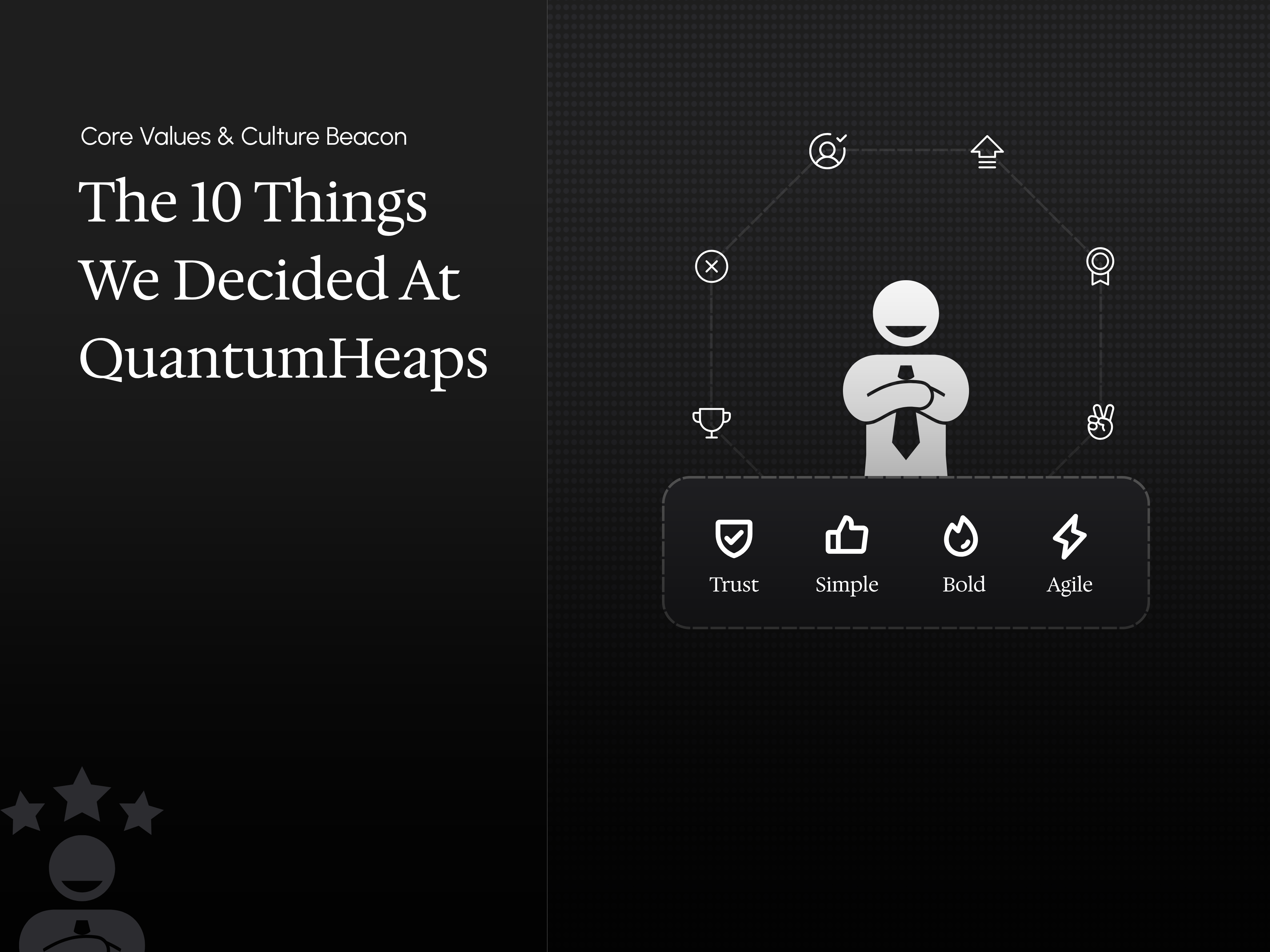
That foundation has ten pieces. Four core values. Six culture beacons. All of them are interconnected. All of them are non-negotiable. And all of them, I want to be clear, are not words we put on a wall and walk past. They are the lens through which we make decisions, hire people, resolve conflict, and define what winning actually means.
This is what they mean, and why we chose them.
Part One: Our Four Core Values
1. Trust: Built on Reliability, Driven by Integrity
I want to be honest about something: trust is the hardest value to put first, because it’s the one that demands the most of you.
Trust is not a feeling. It’s a track record. It’s the sum of a thousand small decisions – did you do what you said you’d do? Did you tell the truth when the truth was inconvenient? Did you show up, especially when no one was watching?
In most companies, trust is assumed until it’s broken. At Quantum Heaps, we treat trust as something we actively build every single day. Every customer conversation. Every internal meeting. Every time we make a commitment, large or small. We believe that the only sustainable foundation for anything (a product, a relationship, a company) is the knowledge that the people around you will do exactly what they say they will.
I chose to put trust first because I’ve seen what happens when it isn’t. When teams operate without it, everything becomes harder. Decisions slow down because no one takes anyone at their word. Energy gets wasted on verification instead of creation. Talented people leave because they can’t work in an environment where integrity is optional.
If you join Quantum Heaps, you’ll notice that we talk about trust not as a virtue but as a practice. We say what we mean. We mean what we say. We own our mistakes without burying them. That’s not idealism, it’s the only way to build something that lasts.
2. Simple: Complex Processes Made Effortless
Here is a truth I have seen proven across every industry, every culture, every level of an organisation: complexity is often a disguise for unclear thinking.
When something is truly understood, when someone has done the hard work of thinking a problem all the way through, it can almost always be explained simply. When it can’t be explained simply, the problem usually isn’t the audience. It’s the idea.
We built simplicity into our culture as a value because we believe clarity is a form of respect. Respect for your customer’s time. Respect for your colleague’s attention. Respect for the person who will eventually inherit the process you designed, the code you wrote, the email you sent.
“Simple” doesn’t mean shallow. It doesn’t mean we avoid nuance or hard conversations. It means that whatever we do, building a feature, writing a proposal, designing a workflow, giving feedback – we do it in the most elegant, accessible form possible. If we can’t explain what we’re doing in clear terms, we go back and think harder until we can.
This value has saved us more time than any tool we’ve ever used. When someone comes to a meeting with a complicated solution to a problem, the first question we ask is: is there a simpler way? More often than not, there is. And the simpler way is almost always the better way.
3. Bold: Daring Ideas, Fearless Execution
This one is personal to me.
I left a very good job, a stable, well-compensated, highly respected leadership role to start something from zero. People who knew me weren’t surprised. People who knew me well understood why: I’ve never been able to sit comfortably with “good enough” when I could see what “better” looked like.
Boldness isn’t recklessness. It isn’t charging at problems without preparation or making big bets without doing the thinking. Boldness is the courage to act on your conviction even when the safer option is right there, offering you comfort and familiarity.
At Quantum Heaps, we celebrate bold decisions. We create an environment where people are genuinely encouraged to raise the idea that sounds too ambitious, to challenge the assumption that “this is how it’s always been done,” to say out loud: “I think we can do this better.” We do not punish failure born of genuine courage. We learn from it, quickly, and we go again.
The team members who thrive here are the ones who bring their whole conviction to the work. Who don’t pre-edit their ideas before sharing them. Who are willing to be wrong in pursuit of being right about something important.
If you’ve been in a place where bold ideas got smoothed away before they ever reached a decision, where the culture rewarded caution over creativity, I want you to know that Quantum Heaps was built explicitly to be the opposite of that.
4. Agile: Fast to Adapt, Faster to Deliver
Speed is not just a strategy at Quantum Heaps. It is a deeply held belief about how great work actually gets done.
There is a version of “agility” that most companies perform. They have the stand-ups, the two-week sprints, the agile coach somewhere in the org chart. But beneath the process theatre, decisions still take weeks, approvals still move through layers, and the thing that needed to happen in January ships in April.
That is not what we mean.
When we say agile, we mean a team that genuinely operates with a sense of urgency. Not panic, urgency. The belief that the window of opportunity is real and finite. That the customer who is waiting for an answer deserves one today, not at the next available slot. That a market insight acted on in three days is worth ten times more than one acted on in three weeks.
Agility also means intellectual adaptability. The willingness to change your mind when the evidence changes. Do not be so attached to your original plan that you miss what’s actually happening in front of you. Some of the best pivots, in products, in strategies, in careers happen when someone is honest enough to say: “I was wrong. Here’s what we should do instead.”
We move fast at Quantum Heaps. Deliberately. With accountability. And we believe the teams who move fast with integrity will outperform those who move slow with caution, every single time.
Part Two: Our Six Culture Beacons
If our values are the compass, our culture beacons are the behaviour, what it actually looks like, on a Tuesday afternoon in a hard meeting, to live those values. They are the habits we hold each other to. The norms we protect. The signals that tell you, within your first week here, exactly what kind of team you’ve joined.
1. Customer First: We Obsess Over What Customers Need, Not What Competitors Do
There is a quiet trap that many growing companies fall into: they stop building for customers and start building for the competitive landscape. They watch what the market leader is doing and race to match it. They optimize for comparison charts instead of outcomes.
We made a deliberate decision not to live in that trap.
Customer First is not a customer service slogan at Quantum Heaps. It is an operating philosophy. When we debate a product decision, the question that closes the argument is not “what is the competitor doing?”. It’s “what does our customer actually need?”. When we prioritise a roadmap, the voice that matters most is not the analyst or the investor. It’s the revenue leader sitting in a forecast call at 8am, trying to get a number he/she can stand behind.
This orientation sounds obvious. In practice, it requires constant vigilance. Markets are noisy. Competitors are visible. Customers are sometimes quiet about what they need most. Customer First means doing the harder work: asking, listening, following up, and then building with the kind of care that comes from genuinely understanding someone’s day.
2. Own It: Accountability, Urgency, and Frugality in Every Decision
“Own It” might be the shortest of our beacons. It is also, day to day, one of the most defining.
What does it mean to own something? It means that when you’re given a task, a project, a customer relationship you take full responsibility for its outcome. Not 80%. Not “I did my part.” All of it. If something goes wrong, the question isn’t who else contributed to the failure. The question is: what are you doing right now to fix it?
Ownership also means something about how you spend. We are a startup. Every pound, every dollar, every hour is a resource that could have been used differently. We ask our team to make spending decisions on tools, on time, on people with the same care they’d apply if it were their own money. Because in a very real sense, it is. The frugality we ask for isn’t about being cheap. It’s about being intentional.
The people who thrive here don’t wait to be told. They see what needs doing and they do it. They come back with outcomes, not updates. That ownership culture is something we protect fiercely because it is the difference between a team of contributors and a team of leaders.
3. Relentless Excellence: Good Enough Never Is
I want to be clear about what this beacon is not. It is not perfectionism. It is not the kind of “excellence” that paralyses you with endless refinement while the window closes.
Relentless excellence is the refusal to be satisfied with work you are not proud of. It is the small voice that asks, every time you’re about to submit or ship or send: is this the best version of what I can do right now?
Sometimes the honest answer is yes, and you ship it. Sometimes the honest answer is “it needs one more hour” and you give it that hour. The difference between the two requires judgment, which is why we hire people capable of making that judgment, and we trust them to make it.
In a world where mediocre work is everywhere, where AI can generate passable content in seconds, where “good enough” is increasingly the norm. The teams that hold themselves to a genuinely higher standard will stand out in ways that matter. Not because we tell people to. Because we have built a culture where doing excellent work feels normal, expected, and personally satisfying.
We want every person at Quantum Heaps to be able to look at what they built and feel proud. Not relieved it’s done. Proud of what it is.
4. Stay Human: Lead With Empathy, Check Ego at the Door
Growth has a side effect that nobody talks about in the company-building playbooks: it can make you harder.
The pressure to scale, to hit targets, to make payroll, to close the quarter – all of that, if you’re not careful, can gradually erode the thing that made you worth working for in the first place. The ability to see people as people. To ask how someone is doing and actually want to know the answer. To give feedback in a way that builds someone up rather than strips them down.
“Stay Human” is our reminder to ourselves, as much as to anyone we hire, that the growth lever is not more important than the human beings pulling it.
In practice, this means we lead with empathy. We give people the benefit of the doubt. We have the hard conversations with care rather than avoidance. We check our ego, especially in success, which is when ego tends to expand most dangerously and we stay curious, humble, and genuinely connected to the people around us.
The teams I’ve seen do the most extraordinary work in my career were never the ones with the best individual talent. They were the ones where people actually cared about each other. Where trust was real, not performed. Where showing up mattered beyond your output.
That’s the team we are building.
5. Shared Wins: We Win or Lose Together
Here is how politics usually starts in a company: teams begin to optimise for their own metrics rather than the company’s outcome. Sales blame the product. Product blames engineering. Marketing gets credit for wins and engineering gets blamed for losses. Individual performance starts to matter more than collective success.
Shared Wins is our antidote to that dynamic but it goes deeper than “be a team player.”
It means that when there is friction between two parts of the organisation and there always will be, in any honest, growing company we resolve it by focusing on the outcome we both want, not on who gets credit or who is right. We sat on the same side of the table. We define success together and we hold ourselves collectively accountable to it.
It also means that we celebrate wins together. Genuinely. Not with performative shout-outs in a Slack channel, but with the kind of recognition that acknowledges the real work: the late nights, the difficult calls, the problems that got solved before anyone noticed they existed.
If you are someone who is energised by collective achievement who finds more satisfaction in a team winning than in being the standout individual you will feel immediately at home here.
6. No Politics: Decisions Over Discussions, Action Over Alignment Theatre
I have wasted years of my career in meetings that existed to discuss other meetings. In organisations where “alignment” was a full-time job. Where the real decisions happened in hallway conversations between the people with the most political capital, and the official process was decoration.
We built “No Politics” into our culture beacons because I refuse to build that company.
No Politics doesn’t mean no disagreement. Disagreement is healthy. It’s how you stress-test ideas and find the right answer. No Politics means that once a decision is made with the best available information, we act on it. We don’t relitigate. We don’t passive-aggressively undermine. We don’t wait for consensus that will never fully arrive.
It also means that access, influence, and opportunity at Quantum Heaps are not determined by who you know or how good you are at managing up. They are determined by the quality of your thinking, the impact of your work, and the character you demonstrate under pressure.
If you’ve spent time in organisations where politics was the invisible tax on everything, where good ideas died because they came from the wrong person, or where the most vocal voice carried more weight than the most reasoned one, I want you to know we are building something different. Not perfectly. Not without the normal friction of humans working together. But intentionally, consistently, and as a matter of genuine cultural conviction.
In Closing: The 10 Things That Define Us
Four values. Six beacons. Ten principles that, when they work together, create something that is genuinely rare: a company where the values on the wall are the same values in the room.
I won’t pretend we always get it perfectly right. Culture is not a destination, it is a daily practice, an ongoing decision to keep choosing the harder path over the easier one. But I can tell you that these ten things are not aspirational for us. They are operational. They show up in how we hire, how we resolve conflict, how we make product decisions, and how we define success.
If you’re reading this and something in these values resonates, if you’ve worked somewhere where trust was performative, where boldness was quietly discouraged, where the human side of work was treated as secondary to the business side then I want you to consider what it might be like to work somewhere where these things are actually real.
That’s what we’re building at Quantum Heaps.
Not just a product. A place.
Interested in joining the team or learning more about how we work? Visit quantumheaps.com or reach out directly. I reply to everyone.